
.webp)
Banking institutions operate on a series of contracts that define risk, revenue, and accountability. Each vendor relationship, loan agreement, or financial instrument originates from contractual obligations. As banking ecosystems grow, the volume of contracts increases much faster than legal capacity.
The Reality of Contract Management at Banking Scale
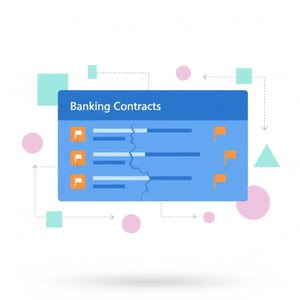 Most banks still operate agreement processing on fragmented systems, emails, and manual reviews. These traditional workflows have resulted in slowing down execution and are more exposed to compliance failures. Financial impact multiplies across portfolios when contract cycles stretch into weeks.
Industry studies consistently demonstrate that ineffective contract management erodes enterprise value. Legal teams use disproportionate time tracking documents instead of analyzing risk, and compliance teams are reacting after issues surface instead of preventing them upfront.
Generative AI introduces a different operating model for banking contract management. It turns unstructured contracts into structured, searchable, and actionable intelligence. The blog discusses how GenAI transforms banking contract management from constraint to catalyst.
Key Takeaways
- Manual management of banking contracts leads to delays, cost overruns, and compliance risk.
- GenAI reduces timelines for reviewing and executing contracts by wide margins.
- Automation improves accuracy at higher volumes of contracts.
- Banks attain quantifiable ROIs through cost reduction and labor optimization.
- Centralized contract intelligence prevents revenue leakage.
- GenAI fortifies regulatory readiness and audit confidence.
- High-volume execution enhances customer experience and trust.
GenAI and the New Speed of Contract Execution
Traditional methods of reviewing contracts rely on humans reading through heavy blocks of legal language. For large banks, that often means hours upon hours each year of manual review.
These huge workloads further cause bottlenecks in the processing, reporting, and risk assessment stages. GenAI makes use of natural language processing (NLP), machine learning, and optical character recognition.
Using these technologies, terms and obligations can be extracted from documents with accuracy and precision. Instead of reviewing each and every document, AI extracts the key data points in minutes or seconds.
GenAI significantly reduces the review time required for compliance and context awareness.
Extracting Insight at Machine Speed
 GenAI ingests large contract repositories faster than traditional manual review ever could. It automatically identifies obligations, expiry dates, liabilities, and compliance terms.
Using advanced NLP models, AI can parse complex banking contracts in minutes. Advanced AI technologies remove all the tedious work of manually searching for keywords, clauses, and other repetitive tasks in reviews.
That means less time confirming terms for the legal teams and advising the stakeholders. Automatic extraction means higher accuracy, with fewer missed clauses or contradictory terms.
Contracts that require weeks of human review are now complete in hours or minutes. That is the engine of speed that unlocks more capacity for higher-value legal work and strategic decision-making.
Accelerating the Negotiation-to-Execution Cycle
GenAI enables real-time comparisons of negotiated provisions against corporate legal policies. It flags deviations, suggests alternatives, and aligns contract language with organizational rules.
This means legal and business teams agree on terms more quickly, reducing back-and-forth cycles. Industry benchmarks show automation can speed up negotiation cycles by half or more.
Time-to-execution shrinks because AI pre-validates contract content before legal reviews begin. Time accelerates not just contract cycles but also revenue recognition and operational mobilization.
Mass Automation of Manual Labor
The largest measurable unit of efficiency is full-scale automation. AI handles thousands of complex reviews of contracts simultaneously, freeing human effort to work on higher-value tasks.
Where legal teams spent many hours on routine tasks, AI fills the gap. In banking, automating reviews of contracts has led to measurable reductions in the use of manual labor.
In addition, the financial, compliance, and operational advantages of automation have a cumulative effect. This creates capacity for legal professionals to focus on risk, strategy, and business value, and it changes legal from a processing function into a strategic partner in banking operations.
How GenAI Delivers Speed in Banking Contracts
 AI-driven banking contract management brings direct financial benefits on many vectors. Progressive institutions are able to quantify savings, revenue impact, and productivity gains with precision.
Direct Processing Cost Reduction
Traditional contract management bears the high financial overheads attached to the time taken for legal reviews. On the other hand, automated contract management systems optimize workflows and minimize errors.
Automated extraction reduces human review time and slashes processing costs substantially. Integrated GenAI workflows eliminate superfluous manual steps across contract lifecycles.
For large volumes of contracts in banking, even small savings per contract add up fast. Reduced processing costs, freeing up budget for strategic projects and compliance investment.
AI also reduces reliance on expensive external counsel for routine contract tasks. This enables banks to direct the money saved by minimizing legal spending to core business growth initiatives.
Re-assigning Core Competencies
Automation through AI does not just cut costs; it actually repositions the talent pool in legal and compliance. Repetitive work goes to AI, while interpretation and risk oversight go with highly qualified lawyers.
Reallocation enhances the capacity of legal teams to engage in complex negotiations and regulatory matters. Optimized resources translate into a finer quality of advice and faster operations.
Free time allows the legal team to be partners with business units in value addition initiatives. Strategic work drives the outcomes beyond mere completion of contracts.
The legal counsel can constructively participate in product innovation, risk frameworks, and proactive compliance. This shift changes the narrative: legal becomes a business enabler, not a bottleneck.
Plugging Revenue Leakage
Centralized contract intelligence prevents common sources of revenue leakage. Missed renewal opportunities are generally a result of failures in manual tracking and poor visibility.
Unrealized discounts, rebates, and unclaimed pricing obligations erode profitability over time. AI systems proactively flag renewals and obligations before they become liabilities.
Banks can renegotiate terms or capture revenue properly when systems alert them early. Automated tracking of obligations and milestones avoids expensive process breakdowns, ensuring confident compliance with revenue contracts and operational commitments.
Measuring ROI in Banking Contract Automation
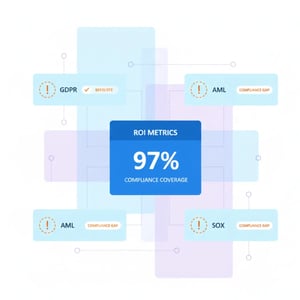 In fact, AI adoption promises strategic gains far beyond mere cost and speed improvements. Benefits such as risk mitigation and regulatory agility become quantifiable for banking legal functions.
Instant Compliance with Interagency TPRM Guidance
Contracts are core to having third-party risk controls and ensuring regulatory compliance. GenAI analyzes agreements instantaneously to verify that the necessary terms exist within the portfolios.
This gets rid of weeks of compliance reviews manually and quickly flags those missing provisions. AI systems standardize the structures of terms and apply compliance templates consistently.
Contractual compliance is an identifiable KPI tracked through agreements and jurisdictions. Such preparedness fortifies institutional defense against regulatory scrutiny and potential penalties.
Navigating Specialized Financial Risk
The high risk associated with certain financial contracts, such as ISDA master agreements and derivative instruments, precludes a totally automated extraction and review. Under traditional methods, it is time-consuming and very susceptible to errors.
Risk-relevant provisions are generally machine-readable, feeding into risk dashboards. AI tools enable the amendment of contracts in bulk when regulatory changes come into being.
This mass remediation ensures compliance with continuity, without manual resource strain. Continuous updates minimize gaps between rule changes and contractual alignment.
Preparing for Regulatory Examinations
Banks are increasingly under stringent scrutiny by regulators and compliance bodies. AI-powered platforms enable swift, on-demand analysis of contract repositories. Legal teams can generate meaningful summaries or reports within short timeframes.
This provides evidence of due diligence, audit readiness, and strong compliance controls. Regulators develop trust when institutions provide evidence of structured, data-driven oversight of contracts.
AI enables legal leaders to respond to scrutiny with documented proof of their compliance posture. This solidifies institutional reputation and decreases examination friction.
From Negotiation to Execution at Scale
While AI clearly transforms the nature of complex agreements, high-volume execution cannot be left behind.
Transforming Retail Execution Speed
 AI integrated with digital stamping and eSignature workflow drives high-volume contract execution. Retail banking agreements include loan documentation, which can be processed much faster at scale.
Related technologies drive turnaround times, and execution cycles for loans fall sharply. Faster contract fulfillment leads to increased customer satisfaction, with resultant competitiveness in the market.
Faster onboarding, compliance checks, and revenue realization are benefits accrued to banks.
Improved Governance and Customer Trust
AI engenders transparency by automatically generating contracts containing preapproved industry and regulatory clauses. Customers experience consistent, compliant documentation that breeds confidence and trust.
Real-time visibility into contract status and approvals strengthens stakeholder communication. Governance frameworks become inherent to the contract lifecycle, not add-ons.
Customer engagement improves as contract delivery becomes predictable and efficient. Simplified eSigning and automated auditing mark every stage with traceable records.
Contract governance thus becomes a differentiator in client experience and brand reputation.
Turning Banking Contracts into Strategic Assets
Contract management in banking has reached an inflection point. Fragmented, manual processes can no longer support the speed at scale, and regulatory expectations of banks contend with today.
GenAI transforms contracts from static documents into structured intelligence that empowers banks to execute faster, comply strongly, and control risk predictably. When contract data becomes searchable, connected, and actionable, legal and business teams move with confidence instead of caution.
This transformation goes to the next level when GenAI operates within familiar ecosystems, such as Microsoft 365. Banks achieve centralized visibility without disrupting existing workflows with contracts managed across SharePoint, Teams, Outlook, and Word. That foundation is what Dock 365 CLM provides: embedding AI-driven insights, automation, and governance directly into Microsoft 365 for streamlined banking contract management that delivers speed, compliance, and value.
Power your banking contracts with Dock 365 CLM. Schedule a free demo now.
Like our content? Subscribe to our newsletter on LinkedIn for more insights and updates.