.webp)
Contract Lifecycle Management systems have long been the foundation of structured contract operations. They centralize documents, enforce workflows, manage approvals, and track obligations across the lifecycle. For enterprises with complex legal environments, CLM platforms are essential.
However, not every organization operates at enterprise scale. Not every contract requires a multi-layer approval chain. And not every legal team needs a system built for thousands of complex agreements with cross-border compliance layers.
This raises an important question: Are there areas where Cowork could realistically replace certain CLM functions?
The answer is yes-under specific conditions. Cowork can replace or supplement selected CLM functions when contract volume is manageable, workflows are simple, and lifecycle tracking requirements are minimal. This blog clearly outlines where that replacement is realistic, where it is partial, and where limitations remain.
When Simplicity Beats Structure: Small and Mid-Sized Organizations
For small to medium organizations handling fewer than 1,000 contracts per year, the operational reality is very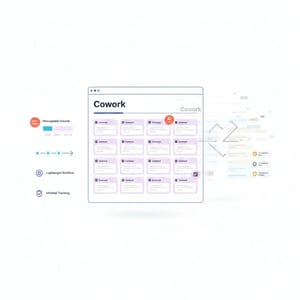 different from large enterprises. Many of these organizations manage straightforward agreements such as NDAs, vendor contracts, and service agreements.
In these environments, contract workflows are often simple.There are no complex approval hierarchies, no multi-regional compliance reviews, and no deeply layered audit requirements. A small legal team-often between one and five attorneys-handles most matters directly.
In such cases, the heavy structure of a full-scale CLM platform may be more than what is required. The cost of enterprise CLM licenses, which can exceed a considerable amount, may not align with the operational needs of a growing company. Cost-sensitive environments often prefer flexible, lower monthly subscription tools.
Here, Cowork becomes a viable replacement for several CLM functions.
Cowork can review contracts, identify key clauses, flag risks, and summarize obligations. It can generate template-based agreements and assist with first-level review. For companies dealing primarily with standardized agreements, this level of capability may be sufficient.
That said, Cowork does not provide full lifecycle governance. It does not natively track renewals, manage obligation reminders,or enforce structured approval routing. For organizations that do not require those features at scale, this limitation may not be critical.
But for companies anticipating rapid growth or regulatory expansion, relying solely on Cowork may create scalability challenges later.
The replacement works best when simplicity is a feature, not a constraint.
NDA Management and Contract Triage: Strong Replacement Cases
Among all contract categories, NDA management presents the strongest case for replacement.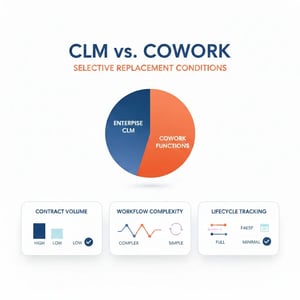
Non-disclosure agreements are typically high-volume and low-complexity. Many organizations process dozens-or even hundreds-of NDAs each month. Most are standardized. Most require minimal negotiation. And most follow predictable structures.
In such environments, speed often matters more than detailed lifecycle tracking.
Cowork can review NDAs, identify deviations from standard terms, highlight confidentiality scope, flag liability caps, and generate summaries within minutes. For organizations primarily dealing with standard NDA templates, this capability can effectively replace a structured CLM workflow.
Legal teams can use Cowork to accelerate turnaround time dramatically. Instead of routing every NDA through a complex system, they can conduct AI-assisted reviews and move forward quickly.
However, limitations remain. Cowork does not provide built-in renewal tracking or long-term obligation monitoring. If NDAs require automated expiration alerts or enterprise-wide reporting dashboards, a CLM system still holds an advantage.
But where turnaround speed is more important than historical tracking, Cowork can function as a practical replacement.
Another strong replacement scenario is contract triage.
Every legal department faces the challenge of categorizing incoming contracts. Which agreements are high risk? Which require senior attorney review? Which can be approved quickly?
Cowork excels at preliminary risk assessment. It can categorize contracts based on clause deviations, identify indemnity risks, flag unusual liability terms, and highlight jurisdictional concerns. This allows legal teams to prioritize effectively.
In organizations where triage is the primary need-rather than structured routing-Cowork can replace that specific CLM function.
It is important to acknowledge that Cowork does not include built-in workflow routing. It does not automatically assign contracts to specific attorneys. Routing decisions must still be handled manually or through external tools.
Even so, for organizations seeking faster intake assessment without heavy infrastructure, Cowork provides meaningful value.
Initial Review, Small Business Use Cases, and Shadow Solutions
Not all replacement scenarios are complete. Some are partial.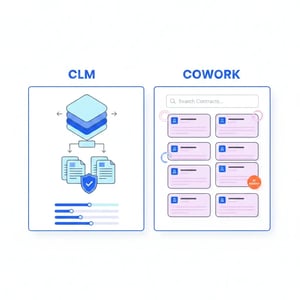
One example is initial contract review.
Cowork performs exceptionally well at first-pass review. It can scan vendor agreements, identify unusual clauses, compare terms against standard templates, and summarize negotiation points. For standard vendor agreements, this significantly reduces review time.
In template-based contract generation, Cowork can also draft agreements using predefined language structures. For repetitive contract types,this can replace basic document generation capabilities within CLM systems.
However, Cowork does not replace final attorney review. It does not create formal audit trails or enforce structured documentation standards required in regulated industries.
Therefore, in initial review scenarios, Cowork serves as a partial replacement rather than a complete one.
The strongest conditional replacement cases appear in small business environments.
Startups handling fewer than 50 contracts per year often do not need enterprise-grade lifecycle management. Professional services firms with simple agreement types may not require automated renewal tracking or advanced reporting dashboards.
For small legal departments with limited budgets, Cowork provides an affordable alternative. It enables contract review, risk assessment, and drafting without major capital investment.
In these environments, replacing CLM with Cowork is realistic.
Yet scalability remains the central limitation. As contract volume increases and agreement complexity expands, the absence of structured lifecycle tracking becomes more noticeable.
Replacement is feasible when contract complexity remains stable and predictable.
Beyond formal legal departments, Cowork also serves an important role in departmental or shadow IT scenarios.
Business units often require quick contract reviews outside the formal legal process. Regional offices without direct CLM access may need preliminary screening before escalating agreements. Third-party vendor relationships may require lightweight review rather than full lifecycle governance.
In these cases, Cowork can operate as a fast review layer.
It can analyze agreements, flag issues, and provide summaries without requiring enterprise-wide system integration. Organizations may even use Cowork in pilot programs to test AI-driven review before committing to full CLM deployment.
This makes Cowork particularly useful during transitional phases.
However, it is important to understand that shadow solutions should not replace structured governance in regulated industries. Where compliance reporting, audit trails, and obligation tracking are mandatory, CLM platforms remain necessary.
So, can Cowork replace CLM functions?
Yes-but selectively.
Cowork can realistically replace CLM functions in environments with manageable contract volume, standardized agreement types, and simple approval structures. It is particularly effective in NDA management,contract triage, first-pass review, and small business contract operations.
It provides cost efficiency, speed, and flexibility.
However, it does not replace full lifecycle governance. Itdoes not manage renewals, enforce structured workflows, or provide enterprise-scale compliance tracking. It does not scale easily to highly regulated or multinational environments.
The key is alignment.
Organizations must evaluate their contract complexity,growth trajectory, compliance obligations, and reporting needs. If those requirements are light and predictable, Cowork may replace selected CLM capabilities effectively.
If governance, auditability, and structured lifecycle management are essential, CLM remains indispensable.
In many cases, the optimal strategy is not replacement but intelligent layering-using AI-driven review to accelerate contract processing while maintaining structured lifecycle oversight where necessary.
Understanding where replacement works-and where it does not-is critical for making informed legal technology decisions.
Final Thoughts: Choosing the Right Model for Your Organization
The legal technology landscape is evolving rapidly.AI-powered tools like Cowork are reshaping how organizations approach contract review and risk assessment.
For smaller teams, growing businesses, and high-volume NDA environments, Cowork can replace specific CLM functions with impressive efficiency. It offers speed, cost savings, and operational simplicity.
But for organizations managing complex contract portfolios with strict compliance requirements, lifecycle governance cannot be compromised.
The most successful legal teams evaluate their operational reality rather than adopting technology based on trend or scale alone.
If your organization is considering whether to rely solely on AI-driven review or implement a full contract lifecycle management platform,the decision should be based on volume, complexity, regulatory needs, and long-term growth strategy.
And if you are looking for a structured, secure, and scalable CLM solution built inside Microsoft 365, Dock 365 provides enterprise-grade contract lifecycle management with automation, governance, and compliance at its core.
Schedule a free demo and explore how Dock 365 can support your contract operations today and build a contract management system that scales with your business.
.webp)

.webp)