
According to Deloitte, many acquisition price adjustments stem from concerns about revenue stability. This highlights a simple truth that legal departments often overlook. Revenue requires more than just a signature; it needs a binding economic arrangement. That’s why legal drafting is now a crucial function for generating revenue in companies.
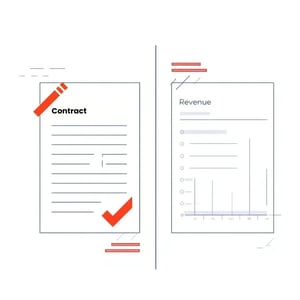
 A contract must pass audits, endure due diligence, and facilitate accurate forecasting.
It should translate legal intent into financial results that finance teams can measure and report reliably. This sets the standard for a revenue-ready contract in today’s organizations.
As a result, many CFOs evaluate contracts before celebrating sales milestones. They seek certainty beyond just written promises, no one wants unexpected surprises in accounting.
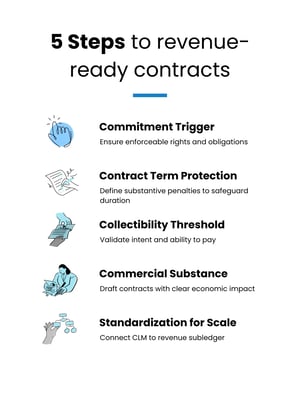
This checklist is meant for entire legal systems, not just individual drafters. It changes contractual documents into predictable economic results that CFOs and investors can trust.
Legal departments sometimes celebrate the signing of a Master Service Agreement (MSA) too soon. From a legal view, the MSA establishes a relationship and sets baseline duties.
However, from a revenue perspective, the MSA frequently does not create any economic commitment. This imbalance leads to a gap between commercial enthusiasm and financial facts.
By default, finance teams see MSAs as frameworks rather than sources of revenue. Unless there’s a clear and enforceable purchase commitment, revenue can't be recognized.
In many cases, an MSA doesn't even count as a revenue contract under ASC 606, which mandates that enforceable rights and obligations exist right away.
Here’s the practical requirement:
Ensure that the signed document generates enforceable rights and obligations immediately. If a separate Statement of Work (SOW) or Purchase Order (PO) is needed, the revenue exists in that document instead. In that case, the checklist must confirm whether the follow-up document has been signed.
The pipeline appears strong; signatures are there, yet recognized revenue might temporarily round to zero. This disconnect harms forecasting accuracy and weakens trust in sales data among executives.
More importantly, it threatens predictability, which is the most valuable aspect of recurring revenue businesses. Revenue-ready organizations address this by identifying where commitment occurs.
 Investors and CFOs think in terms of annualized revenue timelines, not just contract anniversaries. They want to know how long customers are legally obligated to pay.
This is why the duration of a contract is financially important rather than just administratively descriptive. However, termination rights can drastically alter how accountants interpret contract length.
The most problematic type is the “termination for convenience” clause without penalties. Legally, it may seem reasonable and customer-friendly during negotiations.
From a revenue perspective, it quickly undermines certainty in terms.
Most negotiators overlook this:
If a customer can terminate anytime without significant costs, the contract is effectively cancelable. ASC 606 allows auditors to treat the contract as if it’s month-to-month. Consequently, a three-year contract could be viewed as a one-month contract, and the company could lose the ability to report multi-year revenue overnight.
To protect contract terms, companies must establish and articulate significant penalties. These penalties should apply when customers terminate early without just cause. They create financial consequences, thus legitimizing the intended duration of the contract.
Legal departments rarely assess customer financial health when forming contracts. Finance teams often assume that legal departments handle this automatically. However, this gap leads to unnoticed accounting issues.
ASC 606 includes a requirement that many organizations still overlook today: a contract isn’t valid for accounting unless collectibility is likely.
Here’s the relevant interpretation:
The customer must both intend to pay and be able to pay. If either is lacking, revenue cannot be recognized upon signing. Instead, it must wait until collectibility is likely or cash is received.
Organizations should implement a legal due diligence process for evaluating customer finances. This process should confirm creditworthiness, payment history, and commercial intent. These evaluations create documentation that auditors can use to back up revenue assumptions.
Credit checks are an option, but they’re not the only choice. Payment history, investor support, public credit ratings, and escrow agreements are also valid. Strategic teams might also review financial statements for high-risk clients. Each piece of information strengthens the collectibility assessment and significantly reduces audit cycles.
Another drafting control many companies overlook is allowing for the suspension of goods or services if there’s a risk of insolvency. This protects against economic exposure during bankruptcy or restructuring.
It also prevents disputes over non-payment when services continue during financial difficulties. When in place, mitigation rights strengthen both legal and auditing defenses simultaneously.
This approach turns collectibility from an informal expectation into a formal contractual discipline. Handled well, it speeds up the process from signing a contract to recognizing revenue from that contract.
Commercial substance is a test that most legal teams don’t think about. The principle assesses whether the contract meaningfully changes future cash flows. If a contract doesn’t pass this test, it can’t support revenue recognition under ASC 606.
Some companies create agreements that technically exist but don’t change anything financially. These are mere processing documents, legal papers that yield no accounting results. Examples include round-trip transactions, non-binding promises, or barter deals. Auditors dismiss these documents because they fail the commercial substance test.
Contracts must have clear pricing terms and identifiable performance obligations. Lacking either of these generates what auditors call “accounting noise.”
Price structures are seldom as straightforward as negotiators believe. One risk is the difference between price concessions and bad debt events.
If legal teams frequently settle disputes for half the invoice amount, auditors take notice. They view that as an implicit price concession rather than as post-recognition impairment.
This reduces transaction price expectations across the entire customer portfolio. It also lowers reported revenue and could negatively impact valuation multiples.
Revenue-focused legal teams document discount rationales clearly and carefully. They preserve the distinction between commercial variability and credit risk. This clarity leads to better financial reporting and smoother audits.
 The most advanced organizations have uncovered an operational truth. The quality of revenue is not solely a concern for legal and finance; it’s also a data concern.
Customized agreements create chaos for finance and revenue accounting teams. When terms vary from one deal to another, automation falters and spreadsheets overflow.
This results in what CFOs describe as “poor bookings data,” which undermines valuation credibility.
Organizations should transition from custom drafting to standardized contracting frameworks. This involves creating template libraries, controlled deviation matrices, and pre-approved term blocks. It also requires integrating Contract Lifecycle Management tools with revenue accounting systems.
Standardized terms support automated revenue recognition processes. They allow signed documents to flow directly into subledgers and forecasting tools. This dramatically cuts down on audit time, due diligence risks, and friction in revenue reporting.
Most importantly, they enable every signature to convert into revenue-ready data instantly. This results in clearer contracted revenue patterns and stronger credibility in CFO reporting.
Revenue recognition is no longer an afterthought for the back office. It’s a key metric for the board that influences valuation, investor confidence, and determines a company’s scalability.
Legal teams are now central to this reality because contracts are the instruments that create enforceable economic rights. If those instruments fail to meet accounting standards, revenue halts, even with signatures collected and work delivered.
Modern companies increasingly depend on technology platforms like Microsoft 365 to establish that operational foundation. By managing contracts, workflows, and compliance within a unified M365 setup, businesses break down silos and enhance the legal-to-finance pipeline.
This is where Dock 365 can make a difference. Built on Microsoft 365, Dock 365 offers structured contract lifecycle management that links legal drafting, obligation tracking, and revenue reporting.
If your organization is ready to convert signed documents into reliable revenue results, book a free demo of Dock 365 and see how it operates in reality.
Like our content? Subscribe to our newsletter on LinkedIn for more insights and updates.