

According to World Commerce & Contracting, organizations annually lose an average of 5.4 percent of contract value. That leakage is mainly because of inconsistent enforcement of contracts and weak post-signature compliance controls.
Aligning Corporate Counsel Strategy with Contract Execution
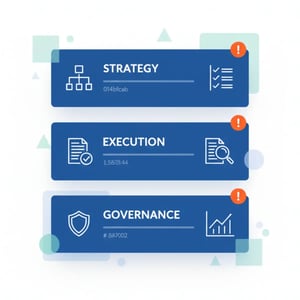 For many organizations, compliance has traditionally been viewed as an administrative need rather than a strategic function. It showed up late in the deal cycle, acted reactively, and often focused on simply meeting minimum regulatory expectations.
That may have worked in a world where the regulatory landscapes moved more slowly and business models were less complex.
Today, that reality no longer exists. Regulatory requirements constantly change, enforcement actions are more and more aggressive, and reputational damage spreads rapidly.
In such an environment, compliance failures seldom remain within the four walls of the legal department. They spill into financial performance, operational continuity, and executive accountability.
This blog explores how compliance becomes a strategic asset when operationalized through corporate counsel contracts. The focus is not theoretical compliance but practical, enforceable, and scalable contract governance.
Key Takeaways
- Corporate counsel contracts are no longer administrative tools but have become a strategic risk-management asset.
- Compliance must be operationalized by means of standardized templates, playbooks, and centralized repositories.
- Zero-tolerance compliance clauses protect organizations against regulatory, financial, and reputational damages.
- Automation and AI improve compliance consistency, but they cannot replace legal judgment.
- Continuous compliance monitoring will be necessary due to the ever-changing regulatory landscape across the world.
- Measuring compliance ROI helps legal teams demonstrate business value.
Corporate Counsel and the Expanding Contract Mandate
Corporate counsel no longer operate in nicely defined jurisdictional boundaries. Global expansion, remote operations, and digital supply chains have erased traditional regulatory borders.
Today, one contract can simultaneously create legal obligations around privacy, trade, employment, tax, and the environment. In this environment, manual interpretation and review cannot scale effectively.
Legal judgment must be embedded directly into contract workflows, templates, and systems. This progression is clear in contract maturity frameworks. Foundational maturity organizations depend on individual expertise and manual oversight.
Intermediate maturity brings in standard templates and negotiated clause libraries. Advanced maturity operationalizes compliance through automation of rules, controlled access, and continuous monitoring.
What differentiates the intermediate from the advanced is not effort; the difference is design. Compliance needs to move from interpretation into execution, and the contracts are that execution layer.
Key Non-Negotiables in Corporate Counsel Contracts
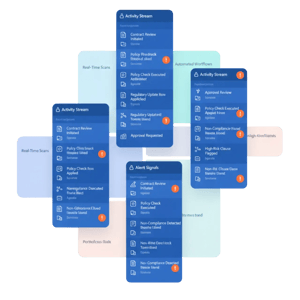 Every organization has some regulatory requirements that cannot be negotiated or compromised. These are no-go areas or zero-tolerance zones, where non-conformity creates unacceptable legal or financial exposure.
Corporate counsel contracts need to reflect such boundaries clearly and with consistency. Zero-tolerance zones convert regulatory requirements into mandatory contractual language.
They take discretion out of high-risk areas and assure consistent enforcement across business units and geographies. If there are not clearly defined standards regarding zero tolerance, compliance becomes subject to individual judgment, especially under pressure.
Data protection obligations are the most obvious example. Newer privacy laws cast heavy contractual burdens on data controllers and processors alike. These burdens are imposed without regard to commercial intent or relative negotiation positions.
Non-negotiable clauses of data protection generally involve:
- Lawful data processing and cross-border transfers
- Timing of breach notifications and reporting obligations
- Security standards, audit rights, subcontractor accountability
These clauses should be fixed controls within corporate counsel contracts. Making them optional or negotiable introduces systemic exposure that no review process can reliably manage.
Employment law presents a different challenge. Local labor statutes frequently override global policies and contractual intentions. Corporate counsel contracts must reflect jurisdiction-specific employment protections and termination standards explicitly.
The Central Repository as the Compliance Source of Truth
Consistency across contracts requires visibility, and visibility requires centralization. Without a centralized repository, even the best-designed templates will fragment over time.
Informal revisions, outdated versions, and unauthorized reuse undermine compliance silently. Governance discipline comes from a centralized contract repository. It keeps every approved template, clause variation, and playbook authoritative and available.
Deprecated language is eliminated with intent, not allowed to live on through habit. It becomes an institutional memory for corporate counsel contracts, retaining regulatory knowledge beyond role or tenure.
It supports audits, investigations, and internal reviews without reconstruction or speculation. Most importantly, a centralized repository makes sure that compliance standards are applied uniformly.
Contract creation begins from vetted, controlled sources rather than personal archives or legacy documents. Without this backbone, advanced levels of compliance maturity cannot remain perpetual.
Architecting the Compliance Playbook
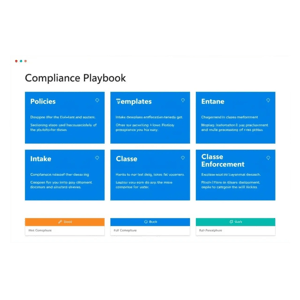 A compliance playbook converts legal policy into actionable guidance, defining acceptable contract behavior under anticipated scenarios and removing uncertainty from routine decision-making.
Standardized templates serve as the initial enforcement mechanism. Each template encodes mandatory compliance provisions based on jurisdiction, contract type, and regulatory exposure.
This ensures that essential obligations are present before negotiation begins. Intake forms greatly strengthen this architecture.
They capture critical metadata before drafting begins, thus allowing systems to apply the right compliance logic in an automated fashion. The goal is not bureaucracy, but precision.
With playbooks, acceptable deviations are then defined. The playbooks define which clauses may be negotiated, under what conditions, and with what approvals. They eliminate ambiguity while preserving flexibility where risk permits.
The result is workload distribution vastly different from that seen now. Routine contracts move smoothly, while high-risk agreements get pointed legal attention. Corporate counsel contracts become predictable, enforceable, and defensible at scale.
Most effective intake processes capture:
- Governing jurisdiction and operational geography
- Involvement of personal or controlled data
- Commercial value and risk profile
- Regulatory, or industry-specific exposure
That information automatically feeds into template selection and clause enforcement. Compliance becomes proactive rather than corrective.
Automation of Compliance Shields
Automation often raises concerns within legal teams, particularly around loss of nuance or control. Those are valid concerns, to an extent, especially when automation isn't done with governance in mind.
But controlled automation amplifies the legal voice rather than diminishing it. Role-based access controls ensure that unauthorized users do not modify compliance-critical content.
Jurisdiction-specific templates, regulatory clauses, and policies are protected against unauthorized or accidental changes.
Artificial intelligence creates another layer of protection: early identification of clause recognition, deviation detection that spots missing or changed obligations. All this reduces reliance on manual reviews for checks on routine compliance.
It does not replace legal judgment; it really brings better awareness and narrows the focus. Human review is inevitable to interpret and make decisions.
Properly deployed automated compliance shields reduce risk while maintaining accountability. Corporate counsel contracts remain compliant by default, not by exception.
Compliance That Adapts Globally
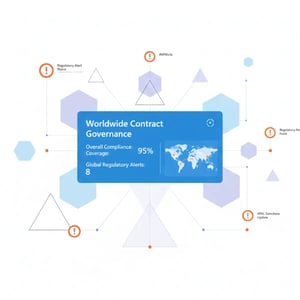 Compliance obligations do not stop at signed contracts. Regulations change without stoppage, and their enforcement expectations shift without consideration for contract cycles. Contracts that cannot keep up become liabilities.
Advanced contract governance requires continuous monitoring of compliance. This goes beyond renewal dates to encompass regulatory effective dates, transition periods, and compliance milestones.
Modern CLM systems automatically track these timelines, warn the legal teams when regulatory changes affect existing agreements, and allow for proactive remediation, thereby preventing silent non-compliance from building up.
Environmental, privacy, tax, and trade regulations frequently introduce retroactive or transitional obligations. Organizations without monitoring capabilities discover violations only after enforcement begins.
Perpetual compliance is taking organizations from reactive defense to proactive resilience.
Measuring Compliance ROI via Corporate Counsel Contracts
Executives expect measurable outcomes from legal investments. Compliance initiatives must demonstrate value beyond regulatory adherence. Corporate counsel contracts provide measurable impact when governance is structured correctly.
Compliance metrics tell about maturity and exposure. Deviation rates reflect systemic weaknesses, whereas template adoption reflects operational discipline. Audit outcomes exhibit enforcement effectiveness.
What are the financial metrics that truly matter? Avoided regulatory penalties, reduced disputes, recovered contract value-translating compliance in a business language.
Training: A strategy for global risk mitigation
Technology cannot create compliance alone: People execute contracts, negotiate terms, and manage obligations daily. Training remains key.
Effective training moves beyond legal theory. It focuses on practical accountability and explains why certain clauses exist operationally. Understanding reduces resistance and errors.
Training must extend across functions. Buying, selling, information technology, and human resources all interact regularly with contracts and need role-specific guidance. One-size approaches fail.
Supporting assets reinforces learning. Quick-reference guides, dashboards, and refreshers sustain compliance awareness across regions. Education becomes more continuous than episodic.
When teams understand what non-negotiables are, friction decreases and risk contracts significantly.
Global Contract Visibility for Counsel
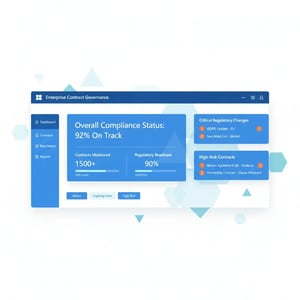 Global organizations usually have fragmented compliance awareness. Regional teams are operating with incomplete context, which creates misalignment and exposure.
Centralized dashboards restore visibility. They provide relevant compliance insights, by role, jurisdiction, and responsibility. Guesswork disappears.
Teams gain clarity on contract status, obligations, and risks. Decision-making improves without adding procedural friction. Transparency strengthens trust between legal and business teams.
Compliance becomes collaborative rather than corrective.
Turning Compliance into Advantage
Compliance is not an option; it's what one does. When thoughtfully integrated into corporate counsel contracts, compliance becomes frictionless, scalable, and predictable.
Risks are easier to predict; governance processes stay consistent, and business growth occurs with greater confidence. Advanced contract maturity shifts legal oversight from reactive monitoring to proactive strategic advantage.
Leveraging platforms like Microsoft 365 ensure centralized visibility, automation, and control over global contracts. Dock 365 CLM builds on this foundation, operationalizing compliance while reducing legal workload.
Turn your corporate counsel contracts into strategic assets. Book a free demo today and see compliance in action.
Like our content? Subscribe to our newsletter on LinkedIn for more insights and updates.