An effectively negotiated framework agreement will yield value for an organization by helping it obtain better prices, better performances from suppliers, and better standardization of purchases among different divisions. The problem is that organizations frequently do not take advantage of the negotiated savings because they do not manage their contracts properly after the signing process.
Here is where the real work starts. A framework agreement may stipulate certain preferences for pricing, performance, and even operations, but these provisions do not provide any value until the organization enforces them. Lack of visibility into everyday transactions and activities leads to the immediate erosion of negotiated value.
For this reason, managing a framework agreement goes far beyond the scope of mere drafting. Organizations require systems that would enable their legal department, procurement department, and even operational units to connect negotiations and terms of the agreement with their actual implementation and performance.
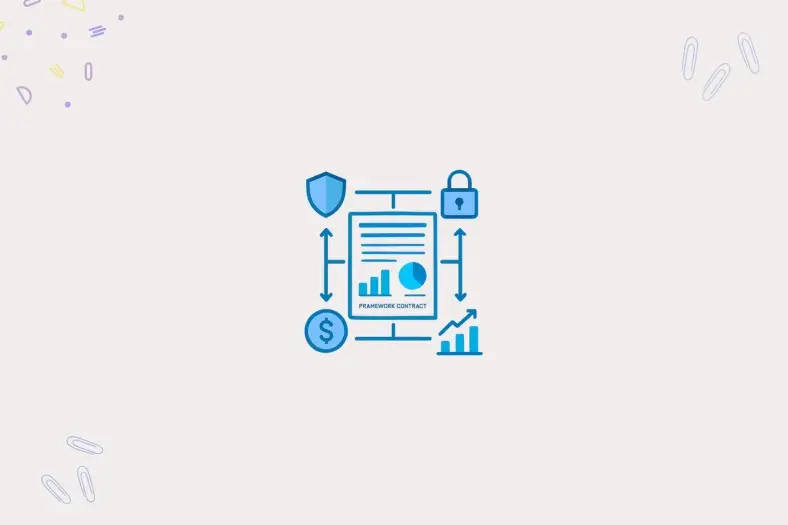
A framework contract is created to make purchases easy and fast by laying out pricing, service level, and other commercial parameters before actual purchases occur. The contract is the master agreement that makes further transactions much easier due to predefined terms and conditions.
However, a framework contract is less beneficial after the signing process. In most cases, the reason for reduced efficiency is not in the contract itself but in its implementation.
One master agreement may be the starting point for a significant number of call-off orders made over time. The number of suppliers involved in the transaction may vary, making it hard to track whether prices and service levels have been followed.
It leads to an incomplete picture for execution. Procurement professionals think that suppliers are delivering at negotiated rates while operations teams concentrate solely on deliveries. The legal department cannot see anything after signing the agreement. Thus, the company lacks control over the terms it negotiated.
A very common situation is the inability to get volume discounts. A framework contract may guarantee some discounts after purchasing certain volumes. However, if purchases are distributed across several departments and tools, tracking such goals becomes impossible. Once this issue is discovered, the opportunity for getting discounts disappears.
The first area where money is wasted is pricing drift. Although prices should be stated clearly in the contract, the supplier may start deviating little by little from those prices. Such discrepancies can remain unseen due to their insignificant character during negotiations. In the end, it will lead to huge losses over many years.
Poor service performance monitoring is also very typical for framework agreements. It is usually required to specify certain service level agreements defining response time, delivery time, and so on. All these points must be controlled because they are critical for receiving discounts.
However, failure of the supplier to adhere to those commitments and lack of oversight leads to the business paying for services that were not delivered and thus wasting funds. In addition, failure to adhere to SLAs affects productivity negatively and creates hidden costs.
Also Read: The Ultimate Guide To Crafting A Solid Service-level Agreement
Another opportunity that is lost in many framework agreements includes critical dates. These include deadline dates for renewal, dates at which rebates can be earned, dates when price reviews are conducted, and termination date. Missing such dates is likely to have significant negative impacts on the financial standing of the organization.
It is also important to note that these losses are gradual. They occur without being noticed by anyone, and accumulate over time leading to huge losses. In fact, most framework contracts under-deliver value because of the above reasons despite successful negotiation processes.
In order to avoid the above losses, organizations must approach the agreement as an ongoing business process. The agreement is signed; the hard work begins from that point on. In order to realize significant savings, continuous governance of the contract is required.
Having a dedicated team responsible for delivering services would help to ensure accountability. If procurement, legal, and operations functioned as one unit, supplier performance metrics would be easier to track. Lessons learned from one purchase could be carried over to future orders, making framework contract agreements more valuable.
Audit clauses are essential components of any framework agreement. Most contracts come with clauses that allow auditors to examine suppliers' compliance, verify prices, and evaluate their services. However, all these measures would be meaningless without the company applying them.
Performance reviews will provide visibility into how the framework contract works. Through these reviews, the business will detect price differences, quality issues, and other problems before incurring losses.
In most cases, businesses have all the necessary tools to streamline framework contract management. What they lack is the proper usage of software. Buying more applications will not be necessary to improve contract visibility.
Microsoft SharePoint may act as a unified platform for storing information about all framework agreements and corresponding call-off orders. Contract documentation, pricing terms, and milestone schedules would be accessible from one place rather than being dispersed across multiple folders.
Centralized management makes it easier to track the contract's lifecycle since procurement will track the agreed pricing, legal will follow up on obligations, and operations will evaluate the supplier's performance.
Using Microsoft Power Automate, organizations can remain proactive in following all deadlines by receiving automatic notifications about their approach. This will help to avoid any delays that usually result in avoidable expenses.
The collaboration will continue with the use of Microsoft Teams which will ensure that legal, procurement, and operations teams are all in one place communicating regarding suppliers' performance, obligations, and any escalation.
With all this technology involved, the implementation of a framework contract is going to become much easier.
A framework contract must not be viewed as an instrument that brings benefit to the organization just by signing it since all these negotiated savings, service level guarantees, and price benefits mean nothing without performance management.
Value leakage becomes unavoidable in the absence of monitoring. Prices become uncompetitive, service requirements are not fulfilled, and key deadlines are overlooked.
These minor issues, over time, undermine the commercial value of the agreement.
However, with the presence of visibility, accountability, and automation, a framework agreement evolves into much more than just a legally binding document. Instead, it becomes an operational tool for safeguarding savings and optimizing supplier performance.
It is here that solutions such as Dock 365 play their role. Developed on top of Microsoft 365, Dock 365 enables companies to unify framework agreements, automate milestones, and increase supplier accountability during the contract lifecycle.
If you think it is time to prevent value leakage and capitalize on each framework agreement, schedule a demo session with Dock 365 right away.
Like our content? Subscribe to our newsletter on LinkedIn for more insights and updates.
Schedule a live demo of Dock 365's Contract Management Software instantly.


© 2026 Dock 365 Inc. All Rights Reserved.