
For many companies, ISDA paperwork is often seen as something to just file away. Agreements get stored, archived, and only pulled out when there's a problem. But that approach doesn't really get what the ISDA framework is all about.
.webp?width=300&height=300&name=The%20Core%20Idea%20Behind%20the%20ISDA%20Framework%20(2).webp) International Swaps and Derivatives Association (ISDA) master agreements are meant to be one ongoing legal relationship, not just a bunch of separate contracts. It's all connected, where each deal builds on what came before.
International Swaps and Derivatives Association (ISDA) master agreements are meant to be one ongoing legal relationship, not just a bunch of separate contracts. It's all connected, where each deal builds on what came before.
This setup lets things like novation, netting, and close-out protections work smoothly. That's why if something goes wrong with one trade, it can affect everything else.
Nowadays, with digital tools, we can actually use this idea the right way. Knowing this is key to understanding everything else.
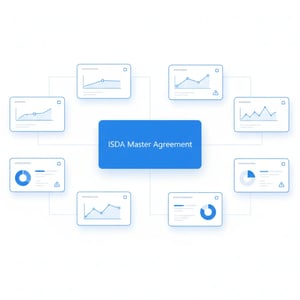 Every ISDA relationship starts with the Master Agreement, but it's often not understood well. Many still see it as just a standard legal paper instead of a working system.
In practice, the master agreement is like a legal operating system. It controls how every future trade acts, reacts, and is resolved if things get tough.
At first glance, it seems simple. Just fourteen standard paragraphs that lay out promises, agreements, and what happens if things go wrong. These parts don't often change, but they're very important.
They define payment duties, what counts as a default, what happens if things end, and how to calculate the final amounts. What makes this so strong is that it's the same for everyone, no matter the market.
The main rules are the same, no matter how many deals you do or how complex the products are.
Choosing between the 1992 and 2002 versions is a practical decision, not just a legal one. The 1992 Multicurrency Cross-Border version reflects earlier settlement conventions and calculation methods.
The 2002 version made close-out procedures more modern and clarified how payments are netted. These changes really affect how disputes are valued if there are defaults or market problems.
Many companies don't realize how much this choice affects their operations. Risk teams, finance departments, and treasury functions all use this logic.
 The master agreement sets the rules, but the Schedule says how to use them. This is where the standard legal setup becomes specific to the relationship and makes sense for business.
The Schedule lets counterparties make their own choices that override the standard rules. Each choice is a trade-off between how much risk you can handle and how much flexibility you need.
Governing law, termination events, and extra promises are all refined here. Small wording choices in the Schedule can have big effects on operations.
Key Person clauses protect against sudden changes in leadership or portfolio managers. These are like tripwires that go off under certain conditions.
With paper documents, these provisions are easily forgotten after they're signed. Digital tools keep them visible, searchable, and actively watched.
Managing the hierarchy is also important in the Schedule. Conflicts can happen between ISDA terms and Prime Brokerage agreements.
Without careful planning, good netting or collateral provisions can be weakened. Managers must make sure the ISDA framework stays in charge.
The Schedule is also where risk policy turns into real documentation. Approved company positions become binding contractual choices.
 The master agreement provides stability, but confirmations provide movement. This is where the legal structure meets what's actually happening in the market.
Each confirmation captures the details of a specific trade. The amounts, pricing, settlement dates, and payment methods are all defined here.
The master agreement governs relationships, but confirmations govern execution. They turn trading plans into real contractual obligations.
In fast-moving markets, confirmations often come after the trade, not before. This adds both speed and risk. The confirmation process relies on the ability to object. Parties have a short time to raise issues or ask for changes.
If no one objects in time, the confirmation becomes legally binding. This puts a lot of pressure on managers and operations teams. Missed problems can create unwanted economic or legal risk.
In the past, confirmations were sent in emails, faxes, or PDFs. This caused delays, duplication, and inconsistent records across departments. Traders cared about the economics, while legal teams cared about enforceability.
Operations teams were stuck in the middle, manually fixing mismatched data. Modern digital workflows change this completely. Trade details can flow straight from trading systems into structured confirmation records.
Managers act as the link between market execution and legal documentation. They make sure confirmed terms match the negotiated schedules and agreements.
This is important for everything that follows. Risk systems use confirmation data to measure exposure accurately.
Credit support documents protect every ISDA relationship. They're there for when markets move a lot, and trust isn't enough.
The master agreement defines rights, but credit support decides who survives when things get tough. It says how exposure is secured when valuations change against a counterparty.
The main choice here is between a Credit Support Annex and a Credit Support Deed. With an Annex, collateral ownership is transferred, which makes enforcement and close-out easier.
With a Deed, a security interest or legal charge is created instead. This is often required by local laws or regulations. Managers need to know the legal and operational effects of both options.
Mistakes here only show up during defaults, when it's too late to fix them. Putting margin into action is where the theory meets the real world. Minimum Transfer Amounts are designed to avoid unnecessary collateral movements.
Without MTAs, teams spend too much time on small transfers. Thresholds say how much unsecured exposure each party is willing to accept. Bad thresholds can increase credit risk over time.
Too-strict thresholds create friction and settlement problems. Regulatory oversight has made these documents even more important.
Audit trails show compliance without having to manually recreate everything. Credit teams can see secured and unsecured exposure in real time.
Risk teams can stress-test portfolios using actual contractual terms. In ISDA master agreements, credit support documents are not optional. They protect companies from market problems.
 Digital tools sit above everything in the ISDA framework. They don't replace the legal structure, but they make it work better and more transparent.
ISDA documentation wasn't meant to be static files. But PDFs and emails turned complex contracts into passive records.
Modern platforms bring back the original idea of ISDA master agreements. They turn negotiated terms into structured, usable legal data.
ISDA Create lets you negotiate online in a controlled and auditable way. Every clause selection becomes a data point, not just buried text.
This creates a single source of truth for the whole company. Legal, trading, credit, and risk teams all use the same agreement data.
The Clause Library helps with this a lot. It replaces copying and pasting with standard, market-tested options. Clauses are organized, tagged, and kept up-to-date as industry practices change.
Negotiation is faster without losing accuracy or legal control. Risk positions stay in line with company standards. Digital tools also get rid of the need to search through paper documents.
Most importantly, contracts become working systems, not just static records.
A good ISDA framework provides more than just legal compliance. If managed well, it can grow to support the entire company. The real benefits are consistency, visibility, and speed.
Companies with structured ISDA master agreements can react faster to market problems. Credit exposure can be found quickly across counterparties and products.
Risk teams get clear information without having to interpret documents manually. The ability to grow is important as portfolios get bigger and markets change.
Static documents struggle with volume, complexity, and regulations. A contract system that can grow treats agreements as active operational assets. Legal data flows easily into trading, credit, finance, and compliance systems.
This reduces problems between departments and gets rid of unnecessary manual work. Efficiency isn't just an internal goal, it becomes a strategic advantage. Platforms built on Microsoft 365 provide the base for secure, company-wide work.
This is where Dock 365 comes in. Dock 365 is a Contract Lifecycle Management platform built on Microsoft 365. It lets companies manage ISDA master agreements as structured, live data. If you want to modernize how ISDA documents are managed, get a demo of Dock 365 and see this system in action.
Like our content? Subscribe to our newsletter on LinkedIn for more insights and updates.