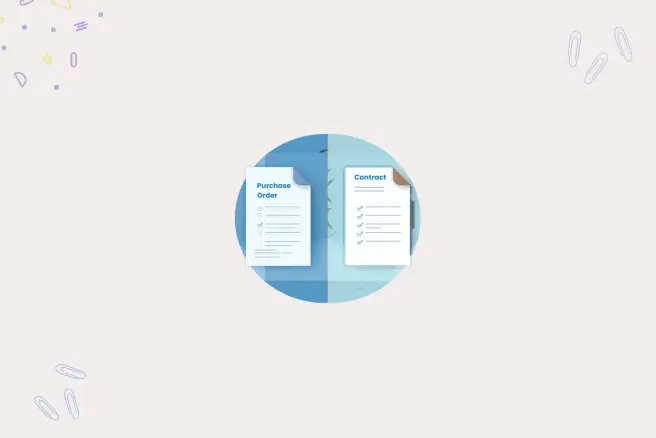
Many organizations believe that purchase orders and contracts provide the same level of protection, but at different costs. This view neglects how regulators, auditors, and courts interpret procurement documents in distinct ways.
 Understanding the difference between a purchase order and a contract clarifies where accountability lies. One document oversees execution, while the other addresses uncertainty, liability, and issues in relationships.
Problems occur when high-value or high-risk activities depend solely on transactional documents. As complexity grows, informal governance measures struggle to scale effectively. Senior leaders often debate whether procurement should standardize purchase orders or contracts.
Successful organizations do not replace one tool with another. They create layered frameworks where contracts set governance, and purchase orders operate within these guidelines.
Grasping the difference between purchase orders and contracts requires looking at how risk surfaces during procurement. These seven differences affect legal enforceability, financial control, and operational strength.
A contract is usually a mutual agreement formally executed by both parties. Obligations, remedies, and liabilities begin as soon as both signatures are present.
In contrast, a purchase order behaves differently under most commercial laws. It is treated as a unilateral offer from the buyer. Legal enforceability occurs only when the supplier accepts that offer, which may happen through written confirmation or by starting work.
This creates a hidden risk that many organizations overlook. Accepting based on performance introduces uncertainty about which terms govern the transaction.
Suppliers can challenge unfavorable clauses by claiming partial or conditional acceptance. Courts often look at actions, communications, and timing to assess enforceability.
Contracts remove this confusion by clearly defining mutual intent. They state when obligations start and which terms take precedence. For complex or high-value deals, clarity is more important than speed.
Written acceptance safeguards both parties by eliminating interpretive risk. Legal and procurement teams should agree on acceptance standards.
 Purchase orders typically rely on standard boilerplate terms. These terms focus on price, quantity, delivery times, and basic payment conditions. This language aims for transactional efficiency, not risk management.
It rarely considers operational failures, regulatory exposure, or claims from third parties. When disputes arise, boilerplate terms offer limited defense. They often lack enforceable indemnities, warranties, or performance obligations.
Contracts intentionally address risk in a careful and fair manner. They outline responsibilities for quality, compliance, intellectual property, and data safety.
Well-crafted contracts anticipate failure scenarios before any work begins. They clarify remedies, escalation paths, and financial effects of nonperformance. This foresight is crucial when suppliers disrupt services or when compliance issues come up.
Without contractual protection, organizations expose themselves to excessive risk. Many procurement teams believe standard purchase order terms provide enough coverage.
This belief fails when losses surpass the transaction's value. Contracts shift risk to the party best able to manage it. This setup fosters accountability and responsible vendor behavior.
Purchase orders are commonly seen as “P-type” instruments. They are meant for quick, transactional procurement of specific goods. Contracts are “C-type” instruments that carry broader governance responsibilities.
They create accountability frameworks for ongoing or complex dealings. Problems arise when P-type tools address C-type risk. This mismatch often occurs in long-term service agreements.
In regulated and public sectors, this conduct is strongly discouraged. Using purchase orders for extended services is viewed as poor governance. Such services need detailed scopes, milestones, and performance benchmarks.
They also require clarity about escalation, fixes, and accountability. Purchase orders lack the depth to support these needs. They confirm the intent of the transaction without monitoring execution quality.
Contracts intentionally bridge this governance gap. They define roles, service levels, reporting requirements, and enforcement processes.
C-type contracts prevent this oversight by formalizing expectations upfront. They provide a solid governance backbone throughout service delivery.
 Purchase orders cater to fixed, well-defined transactional needs. They specify quantities, prices, and delivery details with little flexibility.
This rigidity supports efficient procurement of standardized goods. However, it creates issues when projects involve changing deliverables or dynamic execution circumstances.
Contracts are purposefully structured to allow controlled change. They include formal processes for amendments, change orders, and approvals.
These processes create clear paths for expanding or adjusting the scope. They help keep commercial, operational, and legal goals in sync.
Projects involving technology, construction, or professional services often see changes in scope. Unplanned needs can arise from innovations, regulatory shifts, or operational dependencies.
Organizations relying just on updated purchase orders experience accountability gaps. Levels of authority, price changes, and delivery details often end up inconsistently recorded.
Purchase orders are vital in financial systems. They set formal spending commitments and help with budget controls. Finance teams use purchase orders to track authorized expenses.
They show a clear picture of planned versus actual spending. Three-way matching is a key financial control process.
This process compares the purchase order, supplier invoice, and confirmation of goods received. It makes sure payments match what was ordered and what was received. It greatly reduces duplicate payments, overbilling, and unauthorized charges.
According to best practices, three-way matching is a standard compliance requirement. Regulators and auditors regularly examine this control during financial audits. Contracts alone cannot support this transactional verification.
They define duties but do not confirm individual payment transactions. However, contracts are essential for managing financial risk. They set pricing structures, penalties, and payment dispute procedures.
Challenges come up when financial controls exist without a contractual context. Payments may conform operationally but violate agreed commercial terms.
Integrated procurement models solve this issue effectively. Contracts dictate financial rules, while purchase orders carry out approved transactions.
 Purchase orders generally allow for simple cancellation. They often need minimal notice and little justification.
This flexibility works for low-risk, short-term transactions. However, it is inadequate for supplier relationships that involve dependency or continuity risk.
Contracts address termination more precisely. They specify notice periods, termination conditions, and obligations after termination.
Many contracts have clauses for termination fees or damages. These terms assign financial responsibility if agreements end early. Dispute resolution processes are also clearly defined in contracts. They outline governing laws, jurisdictions, and escalation steps.
Without these clauses, disengagement can become unpredictable and contentious. Uncertainty often turns commercial disputes into legal battles. Organizations relying only on purchase orders lack organized exit strategies.
They may encounter unexpected claims or disruptions during termination. Contracts provide clear exit frameworks. They protect both parties by outlining consequences before termination happens.
Traditional procurement models treat contracts and purchase orders as separate documents. This separation creates compliance issues and operational inefficiencies. Modern CLM platforms link contractual governance with transactional execution.
They allow purchase orders to automatically inherit agreed contractual protections. One common method is to use release or call-off orders. These purchase orders operate under master agreements with established commercial and legal terms.
This structure speeds up procurement while ensuring legal consistency. Every transaction aligns with accepted risk frameworks and pricing structures. Centralized contract repositories enhance governance further.
Vendor profiles keep governing agreements for consistent reference and enforcement. When purchase orders are issued, systems can automatically check for alignment.
Non-compliant terms can be flagged before any financial commitments are made. This automation cuts down on manual checks and reduces approval delays.
It also lowers the risk of human error in high-volume procurement areas. CLM platforms enable audit readiness through thorough traceability. Contracts, amendments, and related purchase orders remain fully connected.
 Purchase orders answer practical questions about timing, quantity, and payment approval. Contracts address strategic questions about failure, liability, and accountability.
Treating these tools as substitutes weakens procurement governance. It creates gaps between financial control and legal safety.
Established organizations understand that procurement needs layered protections. Contracts create the governance structures that define acceptable risk levels. Purchase orders carry out transactions within those predefined contractual guidelines.
Modern businesses increasingly use digital environments like Microsoft 365. Procurement governance must adapt to work smoothly within these frameworks.
Manual document handling cannot keep pace with rising compliance demands. Disconnected systems increase risk rather than improve efficiency.
This highlights the necessity of integrated contract lifecycle management. Dock 365 allows organizations to manage contracts directly within Microsoft 365. Contracts, vendors, and purchase orders stay linked throughout their lifecycle.
To see how integrated contract and procurement governance functions in real life, explore Dock 365. Schedule a demo of Dock 365 today to combine contracts, purchase orders, and compliance with Microsoft 365.
Like our content? Subscribe to our newsletter on LinkedIn for more insights and updates.