
Content
- What is a Standard-form Contract?
- What are the characteristics of a Standard-form Contract?
- Are Standard-form Contracts legally enforceable?
- Why are Standard-form Contracts significant?
- What are the limitations of Standard-form Contracts?
- Dock 365 for Standard-form Contracts
| A standard-form contract is a pre-written legal agreement in which one party sets fixed, non-negotiable terms and the other must accept or walk away - also called a "take-it-or-leave-it" or adhesion contract. They are legally enforceable provided they contain the essential elements of a valid contract (offer, acceptance, consideration, capacity, and legality) and do not include unconscionable (Cornell Law LII) or unfair terms. Common examples include software end-user license agreements (EULAs), insurance policies, mobile phone contracts, and rental leases. Businesses use standard-form contracts to reduce negotiation time, ensure consistency across transactions, and accelerate deal velocity - particularly when engaging with large numbers of customers or vendors on identical terms. |
Not every commercial transaction involves negotiation. There are situations when parties have to sign on the dotted line without giving any room to change the terms and conditions. Consumers don’t have the agency to dictate the stipulations when buying software or signing up for a service. Businesses prefer to use stand-form contracts in these questions.
They are easy to generate and execute at scale. If done right, they can speed up the contract lifecycle and help companies close deals faster. However, there are certain things to consider while handling these take-it-or-leave-it contracts, which we’ll be discussing in today’s blog. From essential elements to limitations to best practices, here’s all businesses should know before adopting standard-form contracts effectively.
Standard-form contracts appear everywhere in modern business — from the app store agreement you clicked through this morning to the vendor service contract your procurement team issued last quarter. Understanding how they work, what makes them enforceable, and where they can go wrong is essential for any team that creates, signs, or manages contracts at scale.

What is a Standard-form Contract?
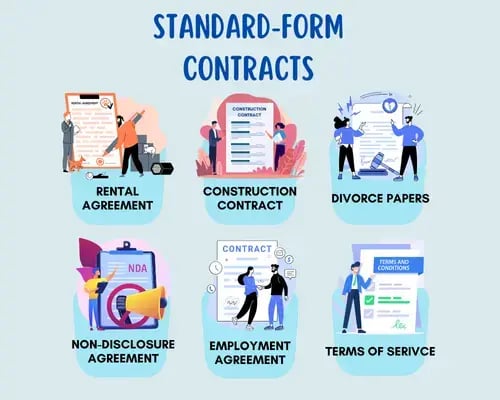
A standard-form contract is a pre-written legal agreement in which one party establishes non-negotiable terms, and the counterparty must accept or leave them. Also known as boilerplate or adhesion contracts, these are applicable for diverse commercial purposes, including rental agreements, service agreements, NDAs, etc.
They leave little to no room for customization by the party accepting the contract. The primary purpose of standard-form contracts is to streamline the contracting process. They work well when the terms and conditions are uniform and relevant to numerous transactions. Businesses can save time and money using a standard-form contract instead of negotiating separate contractual agreements with each client or customer.
Under the Wikipedia definition, a standard form contract is "a contract between two parties, where the terms and conditions of the contract are set by one of the parties, and the other party has little or no ability to negotiate more favorable terms." Courts recognize them as valid contracts provided they satisfy the standard requirements for enforceability. The distinguishing characteristic is the power imbalance: one party drafts, the other agrees. This makes reviewing the terms before signing especially critical for the accepting party.
What are the characteristics of a Standard-form Contract?
Both the parties are involved in determining the terms of the contract in conventional settings. They have sufficient bargaining power to propose stipulations which safeguard their own interests. However, this is not the case in the matter of boilerplate contracts. If you decide to purchase software, subscriptions or merchandise, then you are forced to accept certain terms and conditions without discussion. This is one of the key features of boilerplate contracts.
There are five fundamental characteristics which are shared by all standard form contracts and separate them from conventional contracts. These are as follows: firstly, terms are predetermined by the party having more bargaining power. Secondly, the offer is made in take-it-or-leave-it format. Thirdly, the contract is meant for widespread use through similar transactions. Fourthly, the contracts normally contain boilerplate provisions regarding issues such as liability, dispute resolution and the law applicable to the contract. Lastly, the contract becomes legally binding on account of your signature or acceptance. Not all of these characteristics by themselves render a contract unconscionable.
-
Lack of negotiation
Unlike traditional contracts, where terms and conditions are discussed, negotiated, and tailored to the specific needs of each party, standard-form agreements come with pre-written terms. It means that one party, usually the party with more bargaining power, dictates the terms, leaving the other with no room to negotiate. -
Take-it-or-leave-it approach
There’s no space for compromise or middle ground in standard-form contracts. They often employ a take-it-or-leave-it approach, where the contract owner presents the legal agreement to the other party on a "take it or leave it" basis. Thus, the party receiving the contract must either accept all the terms as they are or walk away from the deal entirely. It can put the party in a disadvantaged position, especially if they have little to no bargaining power compared to the other party.
-
Used in mass transactions
Standard-form contracts are convenient for mass transactions where the same terms and conditions apply to multiple parties. These contracts are efficient for businesses engaging in frequent transactions with customers or clients. Examples of standard-form contracts include insurance policies, software licenses, and rental agreements.
-
Boilerplate language
Boilerplate language typically includes terms and conditions essential for the agreement but may not be specific to the parties involved. While boilerplate language helps to create consistency and efficiency in contract drafting, parties must review and understand these terms before signing. Businesses can customize the boilerplate language to reflect the specific needs of each party and accelerate the drafting process.
-
Signature requirements
In most cases, parties must sign the contract to indicate their acceptance of the terms and conditions outlined. They can aid in enforcing the terms of the agreement in the event of a dispute and serve as a sign of the parties' consent to be bound by it.
Are Standard-form Contracts legally enforceable?
Yes, standard-form contracts are legally enforceable - provided they meet the same basic requirements as any valid contract: a clear offer, unambiguous acceptance, valid consideration, legal capacity of both parties, and a lawful purpose.
From software licenses to insurance policies to rental agreements, pre-drafted contracts streamline transactions and save time for both parties. Eventhough standard-form contractual agreements are legally binding, they must include the essential elements, including offer, acceptance, consideration, capacity, awareness, and legacity. Some other concerns regarding standard-form contracts are the following:
Unconscionability
Unconscionability refers to a contract clause that is so one-sided or unfair that it shocks the conscience. Legally speaking, a contract is said to be unconscionable if one of the parties has substantially more bargaining power than the other and if the terms of the contract are oppressive or unfair. The courts usually avoid enforcing any contracts which are unconscionable.
In cases where standard form contracts have terms that are regarded as unconscionable, the courts will simply not enforce such terms. The business organizations should ensure that they do not have any unconscionable terms in their standard form contracts.
Unfair terms
The standard-form contract may also come under scrutiny for having unfair terms. The unfair terms in the standard form contract refer to terms that cause an imbalance between the duties and rights of the parties to the contract. Examples of unfair terms in standard forms contracts include limiting liability, limiting remedy, and imposing penalty terms.
In order to establish the validity of the standard-form contract, the court needs to look at whether the terms contained in such contracts are fair or not. Where the terms are unfair or unreasonable, the court may rule out the validity of those terms.
Why are Standard-form Contracts significant?
Each time, the need to begin with creating a new contract again may become an obstacle in the way of business. Businesses that aim at bringing their customers on board in bulk need the creation of contractual agreements fast and efficiently. The use of standard-form contracts is able to achieve the task in this case without any compromises on the quality of work.
In cases when organizations work at scale, the use of standard-form contracts becomes not just desirable but rather a requirement for them. If a software company has millions of users, there will be no way to make individual negotiations with all of them. A bank, which provides loans to thousands of its customers, would not have time to make individual agreements with all of them. The three major advantages, such as efficiency, consistency and cost savings, accumulate gradually: each transaction that does not require legal negotiations helps save lawyer's time and money.
-
Efficiency in contracting
It is quite costly and time consuming for business entities to negotiate the terms and conditions with the respective counterparts. The use of boilerplate agreements makes it easy for the concerned parties to make use of standard terms and conditions to deal with the general problems and situations rather than spending so much time negotiating the terms and conditions of a given agreement from scratch.
-
Consistency and uniformity
A company may generate contracts for several purposes, including sales, procurement, and human resources. The contractual agreement must uphold legal, industrial, and organizational standards regardless of the goal and parties involved. Standard-form contracts promote consistency and uniformity in business transactions.
Standardized language and provisions enable parties to ensure that their agreements are clear, unambiguous, and legally sound. When parties employ customized or ad hoc contracts with different terms, miscommunications, and disputes may occur. This consistency helps avoid these situations.
-
Reducing transaction costs
The standard form of contract is a pre-existing template of contract terms and conditions, common in like transactions. The advantage of using the standard form of contract is that the parties do not have to spend time negotiating each term of the contract. The standard form of contract may be useful especially in industries where there are regular transactions.
In the example of real estate industry, the use of standard form of contracts is advantageous in buying and selling of properties. The standard clauses in such contracts include the price at which the property will be sold, the closing date, and any contingencies, among others.
What are the limitations of Standard-form Contracts?
Regarding the signing of contracts, there is a trend of making use of standard-form contracts in many different industries. Standard-form contracts are easy to manage and save time and effort for both sides of the agreement. It is important to learn about the limits of such contracts to avoid unnecessary problems.
-
Absence of tailoring to specific situations
One of the key disadvantages of standard form contracts is their lack of customization. Standard form contracts are created in a way that is supposed to fit all cases, and as a consequence, fail to account for certain situations and needs of individual parties, thus failing to reflect the parties' intentions and resulting in bad relations between the contracting parties.
The main disadvantages of such agreements can be divided into three types. Firstly, standard form contracts are incapable of being adapted to individual circumstances. Secondly, the disadvantaged party in a standard form contract accepts terms they do not quite understand, which introduces an element of imbalance between the two parties. Thirdly, certain clauses of a standard form contract may prove to be unenforceable by the court because of being unreasonable. It is highly recommended to update standard form templates on a regular basis in order to guarantee compliance with the law. -
Imbalance of power
Contracts written in the standard form are often prepared by one party, which has more negotiation muscle than the other party. In such a situation, the contracting party gets conditions that greatly favor them and give the other party very little negotiation strength. This means that the latter has no option but to accept unfavorable terms for fear of losing an opportunity to make a contract.
-
Limited legal remedies
Yet another constraint of a typical contract form is the lack of legal remedy options available to the contracting parties in case of any breach of the contract or in case of any dispute between them. The language of such a contract usually includes boilerplate provisions, which may constrain parties from getting their desired relief or award in case of any breach of the contract.

Dock 365 for Standard-form Contracts
The main aim of using the standard form contract is to speed up the business process. In the standard form contract, certain standardized terms and conditions are incorporated for quick acceptance and implementation. Furthermore, both the parties will have a clear idea about the rights and obligations at the start. It may avoid misunderstandings between the two parties, as they know what to expect from one another.
This is the reason why the boilerplate contract suits perfectly well in the digital contract management environment. You can automate the whole process of contract lifecycle by implementing Dock 365 without any kind of interference. Some of the features which can assist you in making the contract process smooth include:
Template and clause libraries: Dock 365 enables businesses to set up pre-written dynamic templates for standard-form contracts. All users must do is customize specific fields, such as party name, dates, costs, etc. They can also add essential and standardized clauses from the library as per the specific requirements.
Custom workflows: The automated workflows will route the contract through relevant reviewers, approvers, and signatories. These internal and external workflows ensure there are no unnecessary delays in the process.
Electronic signature: Dock 365 seamlessly integrates with DocuSign, Adobe Sign, and Sertifi, enabling users to execute contracts within the contract management platform. They are workflows and alerts to keep the contract on track throughout the signing process.
Schedule a demo today to learn more about Doc 365’s advanced features.
.webp)