
The modern-day business environment has been revolutionized by technology. Businesses today operate faster, smartr, and more digitally than ever before. Technological advancements also enable software solutions that eliminate inefficient hand-to-paper processes and help minimize the bottlenecks within processes.
However, contract lifecycle management services have also witnessed tremendous change. This is because most of these services involve the use of contract management software for contract organization, contract tracking, contract drafting, contract approvals, and for contract storage.
This phenomenon does not only exist in the corporate world. Small and medium-scale companies are now increasingly turning to contract automation in their bid to remain competitive and cut down on risk associated with operations and communication within their organizations.
Contracts are transactional agreements that illustrate how companies will interact with one another. They spell out the terms, cost, timelines, liabilities, and legal safeguards that make sure both parties play by the rules. One contract can affect operations, finance, vendor management, compliance, procurement, sales, and the customer's experience.
This is why organizations require a secure and organized methodology for managing each agreement from initiation to closure; manual processing of contracts will only tend to slow things down, lead to more mistakes, and open up an organization to financial and legal issues.
It is here that modern contract management software provides a great deal of value.
It provides companies with the ability to author accurate compliant agreements, store them securely, track obligations, and reduce risks across the entire contract lifecycle. It enables stronger collaboration between legal, sales, procurement, and finance teams and fosters healthy relationships with customers, suppliers, and partners.
So, why exactly are businesses adopting contract management software?
Let's explore the top five reasons companies use these solutions today.

1. The Digital Contract Advantage: Faster Workflows and Total Visibility
Today, speed, accuracy, and transparency are what make any modern work environment thrive. Businesses cannot afford days, weeks, or any time being spent to distribute any agreements either by emails, printing, or meetings.
Software platforms enable the digitalization of contracts and turn slow manual processes into automated digital processes.
Instead of gaining approvals via multifaceted communication, employees can take advantage of automated routing features that route agreements to the appropriate individuals instantly.
This cuts down the turnaround time drastically and also enables smooth interactions between different teams that could be located in different offices, cities, or perhaps countries as well.
Additionally, digital contracts enhance transparency in the organization. This is because, in the digital system, all stakeholders share the same information in real-time. There shall be no misunderstanding on which document is the latest version or where the current status of the contract resides.
In modern days where telecommuting has become common, electronic contract management tools help in uninterrupted work. Employees can work from anywhere while having all contract information and relevant documents at their disposal.
The companies that continue to work in paper form risk losing contracts, failing to meet their obligations, and getting left in the dust by their competitors who are working at faster rates. There is an increased risk of complying with contracts that are not stored in the same place but in different computers, inboxes, or file cabinets.
Issues of data centralization and review automation and security are overcome by the contract management system by offering access to all the documents. This technological advancement ensures better performance and better decision-making and results.
2. Operational Efficiency Through Automation and Smarter Resource Utilization
Digitization by itself will not work. Today’s business world requires efficient operations. Businesses can and should improve the use of time, talent, and resources.
Contract management software optimizes efficiency by automating the iterative processes that suck the life out of productivity. The mundane tasks of reminding, approvals, checks for compliance, and versioning need not be accomplished by human beings.
Automation helps legal departments rid themselves of administrative work and devote time to high-value activities that add business value.
Many such tools also come up with contract templates and libraries of contract clauses and/or predefined legal language to aid the drafting process and ensure compliance with the least possible errors and efforts.
Collaboration becomes simpler too. Chat functionalities, document approval systems, and online negotiation systems help all the departments communicate within the same system rather than using emails, messages, or calling each other.
Sales representatives can close contracts more quickly. Procurement and vendor management departments can assess the performance of suppliers based on data available in real time. Finance departments get insight into contract value, billing, and renewal commitments.
These collaborative efficiencies enable business growth. Businesses can expand without having to significantly impact the time and people involved. The software will now be a value-for-money asset for the organization, allowing it to achieve more with less.
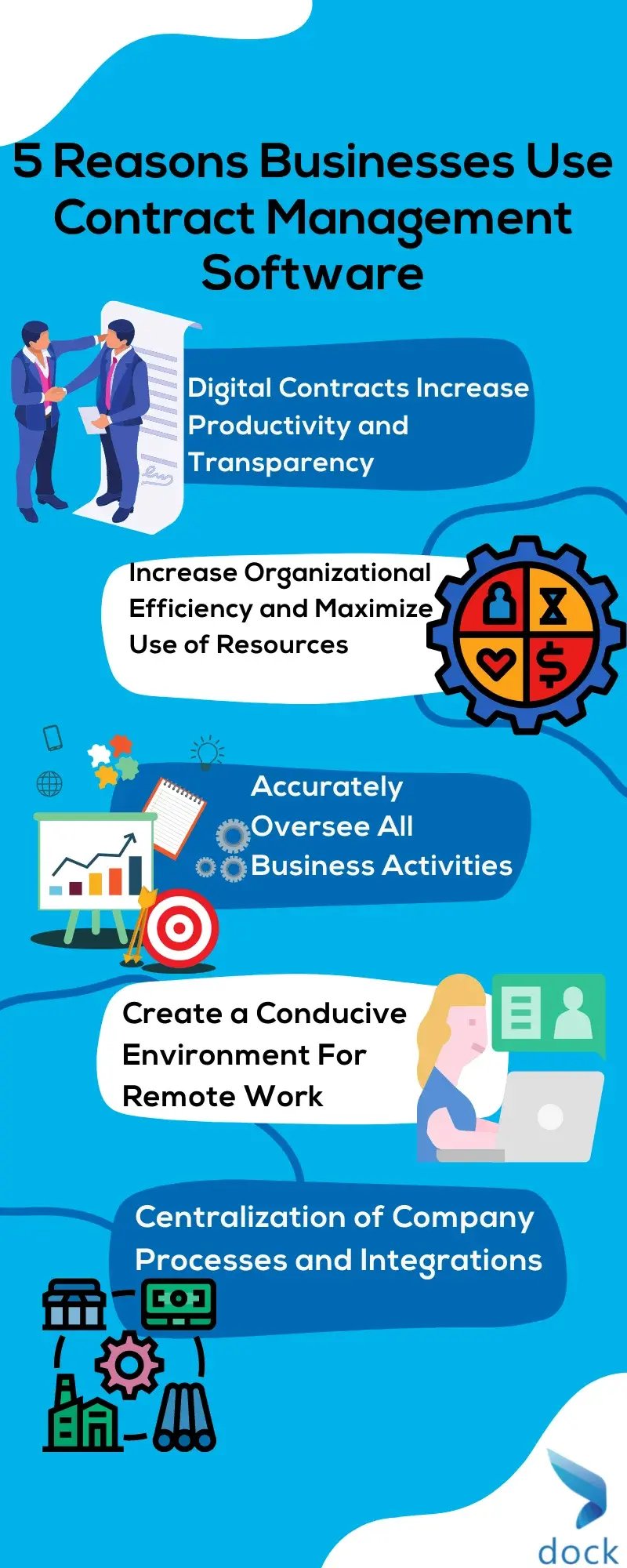
3. Accurate Oversight of Obligations, Renewals, and Performance
Every contract is bound by timelines, commitments, renewal dates, and service level obligations that have a stark effect on overall business performance. A missed deadline or a failure to enforce terms can easily convert into a revenue loss, a compliance gap, or even a deteriorated relationship.
Contract management software solves that problem by means of monitoring and proactive oversight tools.
With digital calendars, automated alerts, and configurable reminders, organizations can use them to track renewal dates, expirations, and critical milestones. This leads to stakeholders being notified well in advance of actions due, thereby minimizing the risk of an unwanted auto-renewal or service interruption.
This helps them avoid a situation where they are stuck in a lousy contract because nobody remembered the renewal date.
Performance of vendors/suppliers can also be tracked through data available. Once a contract is signed, performance metrics along with documentation enabling assessments regarding performance are available to organizations.
A secure cloud repository makes sure that contracts and related documents are well-organized. Now, employees are able to search by vendor, contract, business unit, and even dates without having to rummage through files.
This means that with enhanced supervision, decision-makers receive clarity on the situation. There would be knowledge of the profitable contracts, underperforming suppliers, and contracts requiring renegotiations.
This pro-active approach will improve financial performance, enhance compliance, as well as reduce the risk of operation that unmanaged contracts pose.
4. Supporting Remote Work and Distributed Teams With Secure Access
Today, workforces exhibit a lot of flexibility and mobility. Organizations have remote, internal, and international employees who work from different geographical points and therefore require shared access to documents.
The contract management system helps in this new reality by providing secure and cloud-based access to contracts from anywhere and from any device. Teams in the legal, finance, sales, and purchasing departments do not need to be in the same room.
Organisations have come to realize the dependence that existed on paperwork and physical work being done from the offices. Organisations that had digital contract systems found the process much simpler.
Cloud solutions also have robust backup and recovery processes. In the cases of natural disasters, power outages, and/or hardware problems, the data from the contract will be secure and can be restored.
The other benefit brought about by this digital space is self-service functionality. This means that the team does not have to wait for the response of the legal or procurement functions to get a copy or even basic information on a contract agreement.
Telecommuting is already established as the basis of the business environment. Remote contract management software helps companies remain productive and organized even when employees work from different geographical locations.
5. Centralized Processes, Integrations, and Real-Time Intelligence
Today’s business world utilizes several digital tools for smooth operations. The contract management system improves this by integrating tools such as eSignature solutions, collaboration tools, data visualization solutions, and CRM/ERP systems.
There are no disruptions between the different stages of contracting. For instance, an agreement can be taken directly from negotiation to signing through the use of electronic signatures, then automatically move into the CRM system where billing occurs.
Centralization helps enhance the visibility of contracts within departments. The management is able to assess contract delivery, legal exposure, vendor trustworthiness, and revenue generation capabilities through the use of dashboards.
Real-time metrics empower organizations to make better decisions. Instead of relying on assumptions or outdated files, teams gain accurate insights into:
- Contract volume
- Approval delays
- Renewal pipelines
- Savings opportunities
- Compliance risks
This intelligence transforms contracts into strategic assets rather than administrative burdens..
Why Businesses Choose Contract Management Software?
To clearly answer this question.
Businesses use contract management software because it boosts productivity, increases compliance, reduces risk, speeds up contract cycles, supports remote work, and centralizes critical business data.
It transforms contracts from slow, manual tasks into dynamic digital workflows that strengthen business performance and support scalable growth.
Organizations that adopt these systems operate faster, make better decisions, and maintain stronger relationships with clients and suppliers. In a competitive global market, these advantages are not optional - they are essential.
Final Thoughts
Adopting a new contract management solution may seem challenging at first, but the long-term benefits are substantial. With the right platform, companies can automate, streamline, and secure their entire contract lifecycle without disrupting existing workflows.
Dock 365 makes this transition smooth and productive. Built directly on Microsoft 365 and SharePoint, it integrates seamlessly with tools your teams already use, reducing training and adoption barriers. It offers automation, cloud security, customizable templates, and a centralized repository designed to enhance every stage of the contract lifecycle.
If your organization wants faster approvals, stronger compliance, improved visibility, and less manual work, then contract management software is the clear path forward.
Get Started With Dock 365 Today
Transform how your business manages contracts and unlock higher efficiency with Dock 365’s Contract Management System.
Schedule a free demo with Dock 365 today and see how seamless contract management can be.