The proposal is often viewed as little more than a sales tool that impresses and persuades a client. Yet, in the eyes of the law, even preliminary documents can carry binding implications if not carefully managed.
When a Proposal Becomes a Legal Commitment
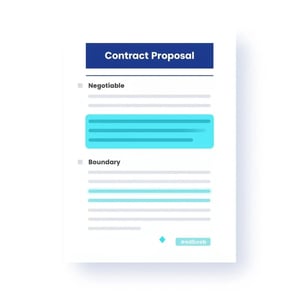 Effective organizations treat proposals as a strategic exercise in maximizing protection while maintaining persuasive impact.
A well-crafted contract proposal strikes a balance among clarity, compliance, and flexibility in negotiation and minimizes exposure before inked contracts exist. By knowing where the pitfalls are, businesses can draft proposals to take clients a yes while avoiding accidental obligation.
It involves treating proposals not purely as sales tools but rather as first contracts that must be drafted with care. Well-structured proposals do less to ignite disputes, protect revenue, and secure long-term business relationships.
Key Takeaways
- A contract proposal can inadvertently be legally binding when terms are specific, signed, or both.
- Ambiguous language and unverified assumptions are significant sources of dispute and financial exposure.
- This includes industries such as construction, SaaS, and government contracting.
- Strategic drafting provides clarity, flexibility, and compliance while preserving persuasive effect.
- Explicit disclaimers and "subject-to-contract" clauses can forestall premature obligations.
- Proper management of proposals builds trust in clients and secures long-term business value.
When Intent Meets Legal Reality
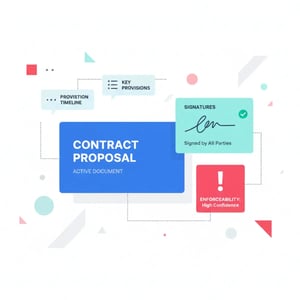 In real life, a contract proposal can often cross the line from suggestions to an enforceable agreement.
The moment a proposal is presented with specificity, a signature line, or stated terms, legal obligations may arise. Understanding the anatomy of such accidental contracts is critical to preventing unintended liability for your business.
Mutual Agreement: There has to be an explicit acceptance of the terms by both parties with no negotiation thereafter. The Courts usually regard signing "as is" as binding consent.
Clear Terms: Unclear terms about the deliverables, timeline, or price invite disputes. Specificity ensures that both parties understand obligations, reducing the potential for conflict or misinterpretation.
Consideration: There must be an exchange of value: Even if implicit, the acceptance of pricing, fees, or services will suffice as consideration under contract law.
Intent to be Bound: The courts would decide if the parties intended to create a binding contract. Signs such as signing or commencing work would indicate legal commitment even in the absence of a contract.
A common pitfall is the “accepted as is” signature line. Businesses beginning negotiations often sign documents that become enforceable obligations.
For industries such as construction or consulting, this risk amplifies. An estimate labeled “proposal” can carry the same weight as a contract if signatures are obtained.
Ultimately, a contract proposal is more than a sales tool; it can turn out to be a legal instrument in disguise. By truly understanding its anatomy, corporate counsel can advise the teams on how to draft safeguards and maintain negotiation flexibility.
Proposals remain informative, persuasive, yet non-binding through careful use of disclaimers, "subject to contract" clauses, and the inclusion of expiration dates.
Why Proposal Risk Varies by Industry
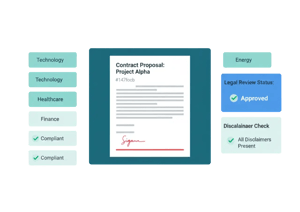 Proposals bear different legal risks, and the industry changes everything in terms of exposure.
Construction and Physical Services: Terms like estimate and proposal are used interchangeably in construction, leading to much confusion. An informal-looking proposal may turn out to become the single version of truth in disputes.
The details should be worded carefully to avoid binding obligations for project scope, materials, and timelines. Even minor discrepancies between the proposal and the formal contract could lead to claims of breach.
Government Contracting: Public sector proposals carry strict formatting and procedural requirements, which further heighten legal risk. The failure to adhere to rules for submissions can lead to disqualification, fines, or reputational damage.
Agencies may construe signature lines or attachments included as binding acceptance. This sets a “legal trap” for firms not conversant with certain procurement procedures.
Clear disclaimers and "subject to contract" terms are very important to allow flexibility in negotiation. The absence of these could result in an innocent pitch being interpreted as a contractual engagement.
SaaS and Technology Services: In technology contracts, Statements of Work (SOWs), have different risks. SOWs are often attached or referenced in proposals, which can inadvertently create binding duties.
Ambiguity in deliverables, timelines, or performance metrics may result in litigation or arbitration. Even a well-intentioned proposal may be misconstrued as binding the company beyond its capacity.
Data, intellectual property rights, and service levels should always be well-defined and qualified. The language should unmistakably indicate that the proposal is preliminary and non-binding in nature until such time as a formal contract has been executed.
Cross-Industry Insight: The risk across all sectors is assuming that labels prevent enforcement. “Non-binding,” “draft,” or “estimate” does not protect a company legally by definition.
The safest approach involves incorporating audit trails, collaborative platforms, and expiration dates. It will ensure clarity, keep the integrity of the negotiations, and avoid accidentally forming a contract.
Why Courts Read Beyond the Heading
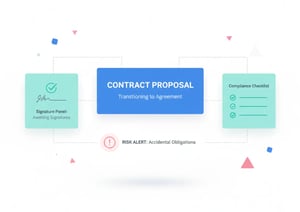 Labeling a document "non-binding" does not necessarily divest it of its legal effects. The courts look beyond terminology in determining whether there was intent, consideration, and conduct sufficient to provide legal enforceability.
Other provisions, such as confidentiality, intellectual property, or liability, may well survive such disclaimers. Sometimes, a signature or acknowledgment can convert what appears to be a preliminary proposal into a partially binding agreement.
Letters of intent are one gray area that exists between negotiation and commitment. While the entire deal may be pending, terms in an LOI can create obligations.
Conduct-based acceptance also presents risks. Commencing work or delivering services in reliance on a proposal may be interpreted as demonstrating intent to be bound, even if the document is labeled draft.
Many businesses believe that mere disclaimers protect them from disputes, which is misleading. The interpretation of the law is based on substance, not form, and looks at what has been done and communicated, not just what has been said.
Drafting strategically serves to preserve flexibility. Explicit statements to clarify that proposals remain preliminary help reduce accidental obligations while guiding counterparties as to next steps and negotiation expectations.
Including expiration dates, "subject to contract" clauses, and scope disclaimers provide added protection. This ensures that proposals serve as persuasive tools for your business, rather than becoming unintentional legal promises.
Corporate counsel must lead teams in understanding that the use of particular wording alone can't avoid binding consequences. Organizations can push forward confidently in proposals with an understanding of the "non-binding" fallacy to help them avoid possible risks.
Designing Proposals That Stay Negotiable
.webp?width=300&height=300&name=Designing%20Proposals%20That%20Stay%20Negotiable%20(3).webp) A well-crafted proposal balances persuasion with clear boundaries, ensuring it does not create legal obligations by mistake.
A well-crafted proposal balances persuasion with clear boundaries, ensuring it does not create legal obligations by mistake.
Strategic disclaimers are important. Clearly state that this document represents preliminary ideas and is subject to revision. This conveys intent yet leaves room for negotiation and avoids inadvertently accepting terms.
The "subject to contract" clause is just as important. Specify that no binding agreement exists until a formal contract is executed. In so doing, this makes sure the counterparties understand that signatures on the proposal do not finalize obligations.
Separation of sales narratives from technical scopes clears up ambiguities. Executive summaries may describe the vision without being committed to specific deliverables. Detailed descriptions of solutions risk being perceived as promises, even when marked "draft" or "proposal".
Contingency and validity periods reinforce protection. Making pricing, timelines, or offers available for a set period of time removes any indefinite obligations. Standard timeframes are 30 or 60 days, after which time the proposal automatically expires if it is not formally renewed.
Corporate teams should combine such measures with internal review processes. Legal or contracts departments will have to check the language before anything gets distributed.
Training sales and project teams about these rules avoids accidental creation of binding commitments with each client interaction.
Using these tactics ensures proposals remain effective as sales tools without exposing your organization to unnecessary legal risk. A carefully structured approach will protect both parties, sustain trust, and set the stage for efficient contract negotiation.
The Final Step in Proposal Maturity
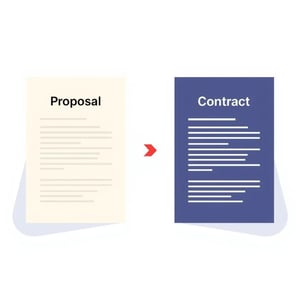 A good contract proposal is more than a sales artifact; it is a controlled gateway into a legally binding relationship. Organizations that treat proposals as casual often discover risk only after acceptance, when leverage is already lost.
Where proposals are drafted with structure, disclaimers, and defined next steps, they preserve flexibility without sacrificing credibility. They will enable commercial teams to confidently sell while protecting legal boundaries that should only activate at the right time.
It is here that modern contract ecosystems make a difference, one that can be measured. Working within Microsoft 365 means proposals evolve inside familiar tools like Word, Outlook, and SharePoint without fragmentation.
Version history, audit trails, and controlled collaboration help more easily demonstrate negotiation intent, not premature agreement.
Proposals will become traceable, governed, and seamlessly connected to the formal contract lifecycle when layered with Dock 365. Drafts, approvals, transitions, and final agreements will all live in one compliant environment instead of being disconnected files.
The consequence is not slower deal velocity, but a wiser momentum whereby every "yes" occurs on purpose, instead of by accident. If your proposals are still exposing your business to commitments that are not intended, it is time for the modernization of the process.
Book a free demo with Dock 365 and see how controlled proposals protect growth without slowing it down.
Like our content? Subscribe to our newsletter on LinkedIn for more insights and updates.