

Contract management and contract administration are related but distinct processes separated by the moment of contract signing. Contract administration covers all pre-signature activities: drafting, negotiating, bid evaluation, routing for approval, and ensuring the contract is coherent before execution. Contract management takes over post-signature: enforcing deadlines, monitoring performance, handling breaches, and managing renewals. According to the Chartered Institute of Procurement & Supply, contract management is "a continuous procurement process that ensures suppliers adhere to their agreed contractual obligations" (CIPS, Contract Management). Both functions are essential - administration sets the foundation; management ensures ongoing compliance.
To ensure that your company is reaping maximum benefits from your contract management and contract administration and management strategies, understanding the similarities, differences, and the gray areas is critical.
Content:-
- What is Contract Management?
- What is Contract Administration?
- What is the Key Difference between Contract Management and Contract Administration?
- What are the Functions of Contract Management?
- What are the Functions of Contract Administration?
- Where do Contract Management and Contract Administration Overlap?
- What are the Intersection Points between Contract Management and Contract Administration?
- What are the Seven Stages of Contract Management?
- What are the Five Best Practices of Contract Administration?
- Conclusion
What is Contract Management?
The Chartered Institute of Procurement & Supply defines “contract management” as the following:
“…a continuous procurement process that ensures suppliers adhere to their agreed contractual obligations along with negotiating any future changes that need to take place” (Chartered Institute of Procurement & Supply, Contract Management).
In simpler terms, contract management is the process that follows signed documentation – this process establishes the deliverables and deadlines that align with the agreement (ProcurePort, 2021).
Our Dock 365 Contract Management System (CMS) offers contract management software that provides an effortless contract management life cycle platform. Implementing our contract management software will improve both contract management and administrative contract management activities across your company.
The Chartered Institute of Procurement & Supply defines contract management as "a continuous procurement process that ensures suppliers adhere to their agreed contractual obligations along with negotiating any future changes that need to take place" (CIPS, Contract Management).
In practice, contract management is everything that happens after a contract is signed. It encompasses performance monitoring, deadline enforcement, breach response, and managing the contract through renewal or termination.
What is Contract Administration?
“Contract administration” functions are related to the contract management.
A contract administrator is often responsible for all activities pertaining to all contracts across your company’s departments. These activities typically occur prior to a contract being carried out (Greaney, 2020). The contract management coordinator primarily ensures that the contract is coherent to contract parameters (Wright, 2017).
Contract administration refers to activities that occur before a contract is executed. A contract administrator ensures the document is legally coherent, metadata is complete, bids are evaluated, approval routing is handled, and all parties understand the terms before signing (Greaney, GateKeeper, 2020).
What Is the Key Difference Between Contract Management and Contract Administration?
The main difference between these two roles lies in the timeline.
The contract administrator will supervise the efforts before a contract is signed.
The contract manager will manage the process after a contract is signed, ensuring all regulations and terms are properly followed according to the contract agreement contents (ProcurePort, 2021).
The core distinction is timeline:
|
Dimension |
Contract Administration |
Contract Management |
|
When it occurs |
Pre-signature |
Post-signature |
|
Primary role |
Contract Administrator |
Contract Manager |
|
Focus |
Drafting, negotiating, approving |
Enforcing, monitoring, renewing |
|
Key activities |
Bid evaluation, routing, metadata |
Breach handling, deadline tracking |
|
Goal |
Create a valid, coherent contract |
Ensure contract obligations are met |
What are the functions of contract management?
Contract management functions include, but are not limited to:
- Executing and fulfilling contracts
- Enforcing deadlines
- Ensuring deadlines are met by all contractual parties
- Contract modification (Hanks, Chron, 2016)
- Conducting periodical contract term reviews
- Attending to breaches
- Interpreting and communicating contract terms (Wahnoun, Evisort, 2021)
What are the functions of contract administration?
Contract administration functions include, but are not limited to:
- Contract implementation
- Inclusion and accessibility of metadata to related parties (Greaney, 2020)
- Extracting and recording deadlines
- Routing for approval
- Information updates
- Bid evaluations and bid requests
- Contract payment calculations
- Troubleshooting contract issues
- Supervising subcontractors
- Contract negotiation
- Designing systematized language
- Soliciting bids from vendors (Wahnoun, 2021)
Where Do Contract Management and Contract Administration Overlap?
To comprehend what this overlap looks like practically, consider an example of a contract with unmet terms and conditions where a contract breach transpires.
In this case, who is at fault? The contract manager, contract management coordinator, or both?
What might be the role of acceptable provisions on a contract by the administrator, and what might be the role of edge case conditions to the execution of contract terms by the manager? What implications to these items contribute to the process? How does risk impact this process?
By considering the relationship between these two roles, you can prepare for these scenarios by ensuring responsibilities are properly delegated. Both contract managers and contract management coordinators must find a balance that propels their roles further by optimizing the contract handling system (Wahnoun, 2021).

What are the intersection points between contract management and contract administration?
It is important to separate and delegate tasks to the appropriate supervisor – either the contract manager or the contract administrator.
Effective communication is required for a smooth contract management and administrative contract management process. We recommend that contract managers regularly communicate with administrators to confirm they have the correct understanding of the contract’s language. Both managers and administrators will certify that agreements with external companies are followed through with ease.
It is best practice for companies to create clarity for employees by defining the distinctions between contract management and contract administration. This can be done by recognizing that they are entirely separate processes that might require some overlap. Continuous and open lines of communication between contract management teams and contract administration system teams, particularly as companies grow, is imperative (ContraxAware, 2019).
A particular example of the intersection between contract managers and administrators occurs when contracts are renewed. In this scenario, contracts with an indefinite lifecycle will be given from the manager to the administrator for renewal, which might entail a renegotiation phase (Wahnoun, 2021).
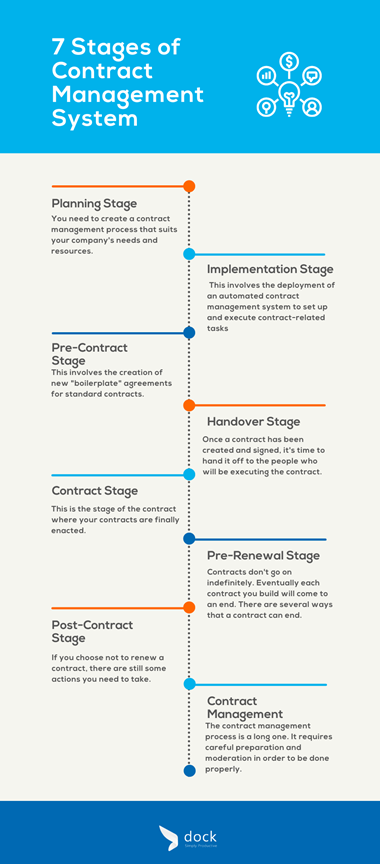
What are the Seven Stages of Contract Management?
-
Planning: evaluate and outline contract objectives and design appropriate management operations to address potential pitfalls and to maximize efficiency.
-
Implementation: utilize contract management software, like our Dock 365 Contract Management System, to automate, simplify, and modernize your contract management process.
-
Pre-contract: consult contract administrators to clarify problems within the contract. In this stage, you develop new agreements for standard contracts.
-
Handover: following contract signature, deliver the contract to the party executing the contract. Ensure all contract details are finalized prior to this step.
-
Contract: fulfillment of contract by vendor and buyer as outlined in the agreement. Employing our Dock 365 Contract Management System can help keep deadlines and deliverables on the correct track.
-
Pre-renewal: re-evaluate the contract and decide to renew, terminate, or renegotiate the existing contract by a specific date. Our Dock 365 Contract Management System provides automated alerts and notifications so that your business never loses sight of a renewal date.
-
Post-contract: verify that contract conditions are fulfilled and invoices are paid prior to archiving the contract. (ProcurePort, 2021)
What are the Five Best Practices of Contract Administration?
-
Design scope and deliverables: outline expectations of the project wholistically and establish clear deliverables that determine what the contract will include and/or exclude.
-
Organize timeline and deadlines: set project dates and specific by-when’s. The project will be measured by the progress on this timeline – timeliness is foundational to contract administration.
-
Attend to financial details: gain familiarity of contract protocols pertaining to payment intervals, review of additional expenses, and contract value.
-
Discuss roles within the team: ensure expectations and roles are clear across your administrative team. Keep team members accountable by identifying internal and external parties in addition to applicable third parties that are in knowledge of contract details.
-
Manage and plan for risk: design risk-management protocols in the event of unforeseen issues and delays (ProcurementPort, 2021).
Conclusion
With proper education of the definitions, functions, intersection points, processes, and best practices about contract management and contract administration in project management, your efforts will be optimized. Developing an understanding of the similarities and differences between contract management and contract administration definition will help you set appropriate expectations regarding each process.
Both contract management and contract administration process activites are essential to your internal contract operations, and with proper guidance regarding the two, your system will be streamlined. We greatly recommend using our Dock 365 Contract Management System to aid you in centralizing and automating your processes in the most efficient fashion.
In essence, the objective is to have a contract management team and a contract administration system team that works in harmony to supervise and ensure the success of a contract throughout its lifecycle. Both management and administration play specific roles based on the timeline of the contract – pre- and post-signature. With well-defined and clear descriptions of the tasks for both the management and administrative teams, your overall process will be set on the path of improvement from the very beginning.