
In every organization, new and emerging plans turn out to be obsolete or undermined if it is met with rising risks. Such unresolved external or internal risks get escalated in a timely manner and seriously hit the productivity and profit goals of an organization.
To bring down the high-complexity rating and correspondingly high risk, it is necessary to implement a set of actions or processes to resolve them quickly. That is where the risk management solution comes into play.
But what is a risk management solution, and how do manage high risks?
Although the term risk is often used in different contexts, the risk is simply an outcome that will not be as expected during the initiation of a new proposal or plan. You need to instantly identify risks, need to analyze risks, prioritize it, a solution is identified and executed, and lastly, the risk is monitored. That way, each time you start a new plan, it is much easier to identify the risks in advance and hold back them instantly. This 5-step process is called the risk management process.
The following listed are the 5-step phases of the risk management process.
Identifying the Potential Risks
What makes things go wrong?
Risks will inevitably come up when taking on new initiatives irrespective of the different working environments of an organization. Merely identifying the potential risks is the prior step that needs to be taken. Make a risk breakdown structure. List out all the risks from the most pre-eminent risks to the less-impacted risks. This will possibly bring in a clear idea of the structure of risks.
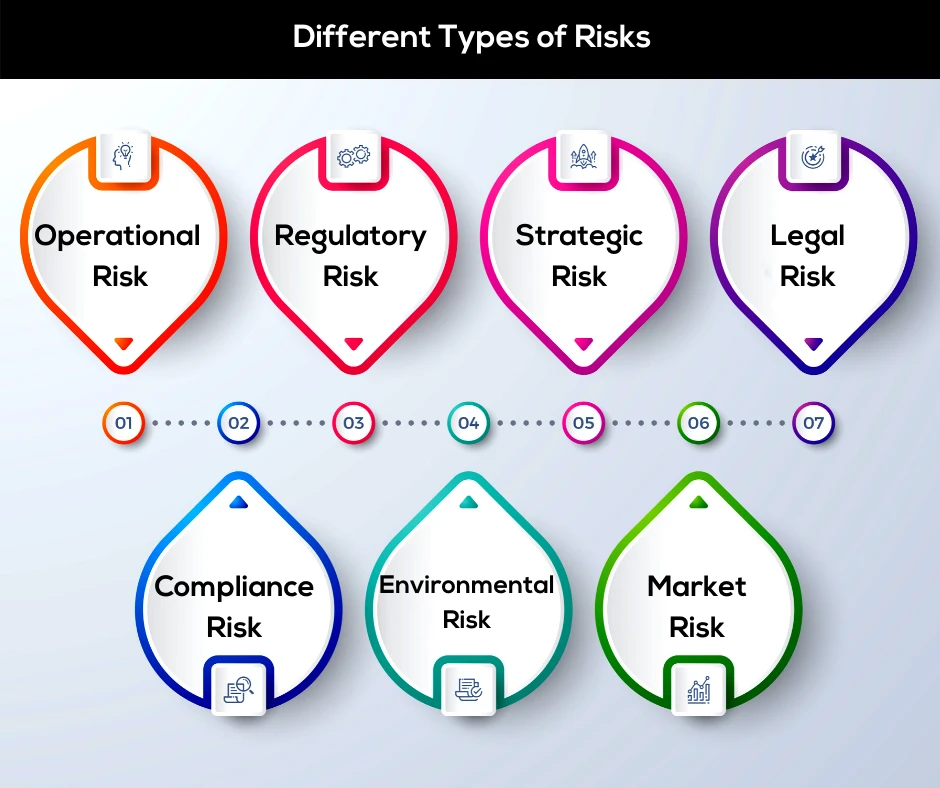
Based on different organizations and their operating environment, the risks that pop-up might differ. Here are the different types of risks that might arise:
Manual risk management is a puzzling task. Also, the increased chances of changing risk situations make it an important task to be revisited regularly. Managing all such diverse risks may sound effortless if an automated risk management solution is implemented in your organization.
Analyzing the Risk
What are the consequences that follow?
Once the problems are identified, it is time to thoroughly analyze the risk impacts. Business aspects like a financial investment, time involved, the severity of the impact, and availability of resources to manage the risks are focused to understand the effects of risks on the organization at different levels. If more of these aspects are affected and are at risk, the higher the risk to the company.
A risk management solution thus aids risk mapping where various risks are mapped into different procedures, policies, and documents. The risks are then evaluated by this mapped risk framework and let you know the sweeping effects of each risk on various business aspects.
Evaluating the Risk
Risk evaluation prioritizes various risks by differentiating the high-impact and low-impact risks separately. Dissecting each risk one by one lets you spot the high-priority risk to focus on. The team can thus focus on such high-priority risks by bringing in workable solutions to immediately reduce the effects and losses.
Implementing workable solutions with the help of a risk management solution can help continue plans and projects without any interruptions and delay. A company with an automated risk management solution thus has different risks in-built in the solution which can easily sort the risks based on their severity and vulnerability. This also eliminates the severity and complication of manual risk evaluation.
Treating the Risk
Treating the risk instantly so that it is no more a threat is the next phase. Once all the risks and their workable solutions are listed, you can start treating the high-priority tasks.
The risk mitigation or workable solutions are:
.png)
Accepting risk means accepting the innate risks that may occur in every business because the profits of the plan will compensate for the risk. By avoiding risk, the organization simply disregards the activity thereby showing non-participation. With risk control, you can reduce the impact that it will cause if it does occur. And finally, by transferring a risk, an organization can transfer the responsibility to another party.
Usually, once the risks and their corresponding mitigation solutions are identified, then manually we must inform every stakeholder and need to get their insights. But with a risk management solution, the information can be delivered in one go from within the system to every stakeholder which thereby makes it easy to track the progress of risk mitigation.
Monitoring and Reviewing the Risk
Risk management is a process that never does have an end. It is always an ongoing process, as the organization, its working environments, and the rising risks keep on changing constantly. So, the final and most important phase is to keep a check on the whole process uninterruptedly.
Certain potential risks like environmental risks and market risks need to be monitored as they exist always. This simplifies the mitigation process too. Moreover, constant monitoring also helps the team to identify if the implemented strategy is effective or not. Thus, developing a risk culture is of great importance to an organization to adapt and overcome the challenges of rising risks and changes in an organization. With Dock’s SafePoint solution, you can easily control your risk management activities and we are ready to help our customers reduce their cost of risk.